


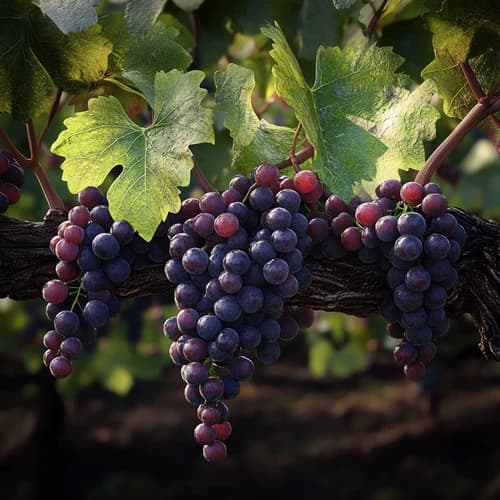


Sicily's Black Pride
Nero d'Avola is the red wine icon of Sicily and has had an impressive career over recent decades. What once served as a robust blending grape for northern Italian wines is today an internationally celebrated grape variety that perfectly captures the sun-drenched temperament of southern Italy in the bottle. With its intense fruit, spicy complexity, and powerful character, this grape demonstrates what Sicily has to offer in terms of wine.
Flavour Profile & Character
Nero d'Avola typically presents itself as a powerful, full-bodied red wine with intense dark fruit. The flavour profile is dominated by juicy black cherries and ripe plums, accompanied by a characteristic Mediterranean herbal spice. The tannins are present and structure-giving but mostly ripe and supple — especially when the grapes have been able to ripen optimally under the Sicilian sun.
Depending on the style and terroir, the variety shows different facets. In cooler higher sites of Sicily, elegantly fruity wines emerge with lively acidity and fine spice. In the hotter coastal regions, Nero d'Avola develops more opulent, higher-alcohol wines with concentrated fruit and velvety tannins. Barrique ageing gives the wines additional complexity with notes of vanilla, chocolate, and sweet spices.
With age, high-quality Nero d'Avola wines develop a fascinating complexity. The fresh fruit shifts towards dried fruits and prunes, while notes of leather, tobacco, and earthy nuances join in. The tannins integrate fully, creating a silky texture that makes the wine even more approachable.
Origin & History
The name Nero d'Avola means "Black from Avola" and refers to the small town of Avola on the south-east coast of Sicily, which is considered the variety's region of origin. The grape does in fact probably originate from this region, although genetic studies also point to possible connections with other Sicilian areas. The variety is also known as "Calabrese" — a name that goes back to a historical confusion with Calabria, even though the variety is unequivocally Sicilian.
For a long time Nero d'Avola was used primarily as a blending partner. The powerful, deeply coloured wines were shipped to northern Italy and even to France to bolster other wines. It was only in the 1980s and 1990s that innovative Sicilian producers recognised the variety's true potential and began producing single-variety wines of the highest quality.
Today Nero d'Avola is Sicily's most important red grape variety and is cultivated on over 16,000 hectares. The grape has found recognition not only throughout Italy but also internationally, and is increasingly cultivated in other Mediterranean countries as well as in Australia and California.
Cultivation & Terroir
Nero d'Avola is perfectly adapted to the Mediterranean climate of Sicily. The variety loves warmth and sun but also needs sufficient water to allow its grapes to ripen optimally. In excessively hot, dry years the wines can become jammy and alcohol-heavy, which is why modern producers are increasingly turning to cooler higher sites.
Sicily's soils are diverse, ranging from calcareous soils through volcanic substrates on Etna to sandy coastal soils. Nero d'Avola proves remarkably adaptable, but develops different characteristics on different terroirs. On calcareous soils more elegant, mineral wines emerge, while volcanic soils produce spicy, complex wines.
The most important growing areas are in south-east Sicily, particularly in the DOC zones of Eloro, Noto, and Cerasuolo di Vittoria (where Nero d'Avola is blended with Frappato). The variety is increasingly also being cultivated in cooler sites at elevations between 400 and 800 metres, where it produces fresher, more elegant wines with better acidity structure. Some producers at the slopes of Etna are also experimenting with Nero d'Avola, with remarkable results.
Wine Styles & Variants
Nero d'Avola is found in various styles. The simpler, fruit-driven versions are aged in stainless steel tanks and drunk young. These wines impress with juicy cherry fruit, Mediterranean freshness, and accessible tannins — perfect for uncomplicated enjoyment.
The more ambitious quality wines, on the other hand, often age for 12 to 18 months in French or American barriques. Here an additional layer of complexity develops with vanilla, chocolate, and roasted notes that elegantly frame the powerful fruit. Some producers also use concrete tanks or large oak barrels (Botti) to foreground the fruit while still achieving structural complexity.
Regional wine styles differ considerably. In Cerasuolo di Vittoria, Nero d'Avola is traditionally blended with the finer, fragrant Frappato grape, producing more elegant, pleasurable wines. On the south-east coast around Noto and Pachino, powerful, concentrated wines with high ripeness are produced. In the higher sites of the island's interior, increasingly fresh, structured versions with mineral character are being made.
As a blend partner, Nero d'Avola pairs excellently with international varieties such as Syrah, Cabernet Sauvignon, or Merlot, which add extra structure and complexity to the Sicilian power.
Typical Aromas
Primary Aromas (from the grape)
Black Cherry: The heart of the aroma profile. Depending on the degree of ripeness the spectrum ranges from fresh, juicy cherry to deeply black, concentrated fruit. In cooler sites the cherry fruit remains more vibrant and precise, while in hot coastal regions an almost jam-like intensity can develop.
Black Plum: Ripe, sweet plums with a light spice characterise many Nero d'Avola wines. This aroma develops especially in warm vintages and gives the wines their characteristic opulence.
Mediterranean Herbs: Typical are notes of thyme, rosemary, and dried herbs — a signature feature that reveals the Sicilian origin. These aromas are especially pronounced in wines from barren, sun-drenched sites.
Black Pepper: A spicy pepper note gives many Nero d'Avola wines tension and complexity. It is especially present in cooler vintages and in wines from higher sites.
Liquorice: Subtle liquorice notes with a hint of anise round out the aroma profile and lend the wine additional depth.
Secondary Aromas (from winemaking)
Vanilla and Chocolate: Barrique ageing brings sweet vanilla notes and dark chocolate aromas that harmonise perfectly with the ripe fruit.
Cocoa: High-quality wines often develop an elegant cocoa note that gives the wine additional richness and creaminess.
Cinnamon and Clove: Through oak ageing and malolactic fermentation, warm spice notes develop that recall Christmas baking.
Tertiary Aromas (from ageing)
Dried Fruits: With age the fresh fruit shifts towards prunes, figs, and dried cherries — a sign of a well-aged wine.
Tobacco and Leather: Aged Nero d'Avola develops elegant tertiary notes of sweet tobacco and soft leather that lend the wine a noble complexity.
Earthy Nuances: With increasing age, fine earthy tones and forest floor appear, giving the wine additional depth.
Nero d'Avola possesses good to very good ageing potential. While simpler, fruit-driven versions are best drunk within three to five years, high-quality, barrique-aged wines can comfortably age for 8 to 15 years, gaining in complexity and elegance.
Food Pairing
Perfect Combinations
Pasta alla Norma: The classic Sicilian pasta with fried aubergine, tomato sauce, roasted ricotta salata, and basil is the perfect accompaniment to Nero d'Avola. The fruit of the wine harmonises beautifully with the sweet tomato, while the tannins balance the creaminess of the cheese and the spicy notes underline the Mediterranean vegetable aromas.
Grilled Lamb with Herb Crust: The powerful structure and ripe tannins of Nero d'Avola are tailor-made for tender lamb. Especially when the meat is seasoned with Mediterranean herbs such as rosemary and thyme, a perfect bridge between wine and dish is created. The grill's roasted aromas reinforce the spicy side of the wine.
Caciocavallo and Pecorino Siciliano: Aged Sicilian cheese is a dream pairing for Nero d'Avola. The salty, nutty aromas of the cheese complement the fruit and spice of the wine, while the tannins balance the fat of the cheese. Add a piece of crusty bread and some honey — perfection.
Beef Pot Roast with Red Wine Sauce: The velvety tannins and spicy complexity of aged Nero d'Avola wines make them the ideal companion for slowly braised beef. The deep, concentrated aromas of the wine harmonise perfectly with the reduced sauce and tender meat.