

Why Riesling Is Germany's Favourite Wine – 3,058 Tastings Prove It
 By Johannes Quernheim · Wine Influencer & Content Creator
3,058 real Riesling tastings analysed: how Riesling tastes, how to spot a great one – and when the extra spend is actually worth it.
Riesling isn't just the most-scanned grape variety in Grape Guru, it's also the highest-rated. We analysed 3,058 real Riesling tastings: how it tastes, how to recognise a great one – and when paying more is actually worth it.
Riesling has an image problem that reality left behind long ago. Many people still picture the sweet litre bottle of decades past. Yet today Riesling is the grape that German wine drinkers reach for most often – and rate the highest.
For the first time, this can be shown with real numbers. In the Grape Guru app, wine lovers have tasted and rated around 24,000 wines. 3,058 of those were single-varietal Riesling – more than for any other variety. What those tastings reveal about Germany's favourite grape is surprisingly clear-cut.
The short answer
In Grape Guru, Riesling is the most-scanned and most-tasted grape variety – and at 83.0 out of 100 points the highest-rated among the major varieties. It smells above all of citrus and minerality (each in roughly two thirds of all tastings), plus stone fruit and apple; tropical fruit, at 3%, is the exception.
Riesling is drunk dry about 70% of the time – yet the highest ratings go to the nobly sweet examples. You'll recognise a great Riesling more by flint, slate and apricot than by green apple. And on price: from around 15 euros it gets genuinely good.
Riesling is the most-tasted – and most popular – grape variety
No variety is scanned as often in Grape Guru as Riesling: more than twice as often as Chardonnay in second place. And unlike many "volume winners", the quantity doesn't come at the expense of quality. On the contrary – Riesling tops both rankings:
| Grape variety | Tastings | Avg. rating |
|---|---|---|
| Riesling | 3,056 | 83.1 |
| Chardonnay | 1,608 | 82.4 |
| Sauvignon Blanc | 1,119 | 80.7 |
| Pinot Noir | 759 | 81.7 |
| Spätburgunder | 668 | 79.0 |
| Pinot Gris | 515 | 79.3 |
| Grüner Veltliner | 461 | 78.3 |
That of all grapes it's Germany's flagship variety that's also the most popular fits the picture: in our tastings white wine is rated far more often than red anyway (roughly 12,000 to 8,400). Riesling is the clear leader of a broad white-wine majority.
What does Riesling really taste like? The aroma fingerprint
We analysed which aromas users describe most often in Riesling – and built a "fingerprint" of the variety from it. The result reads like a textbook.
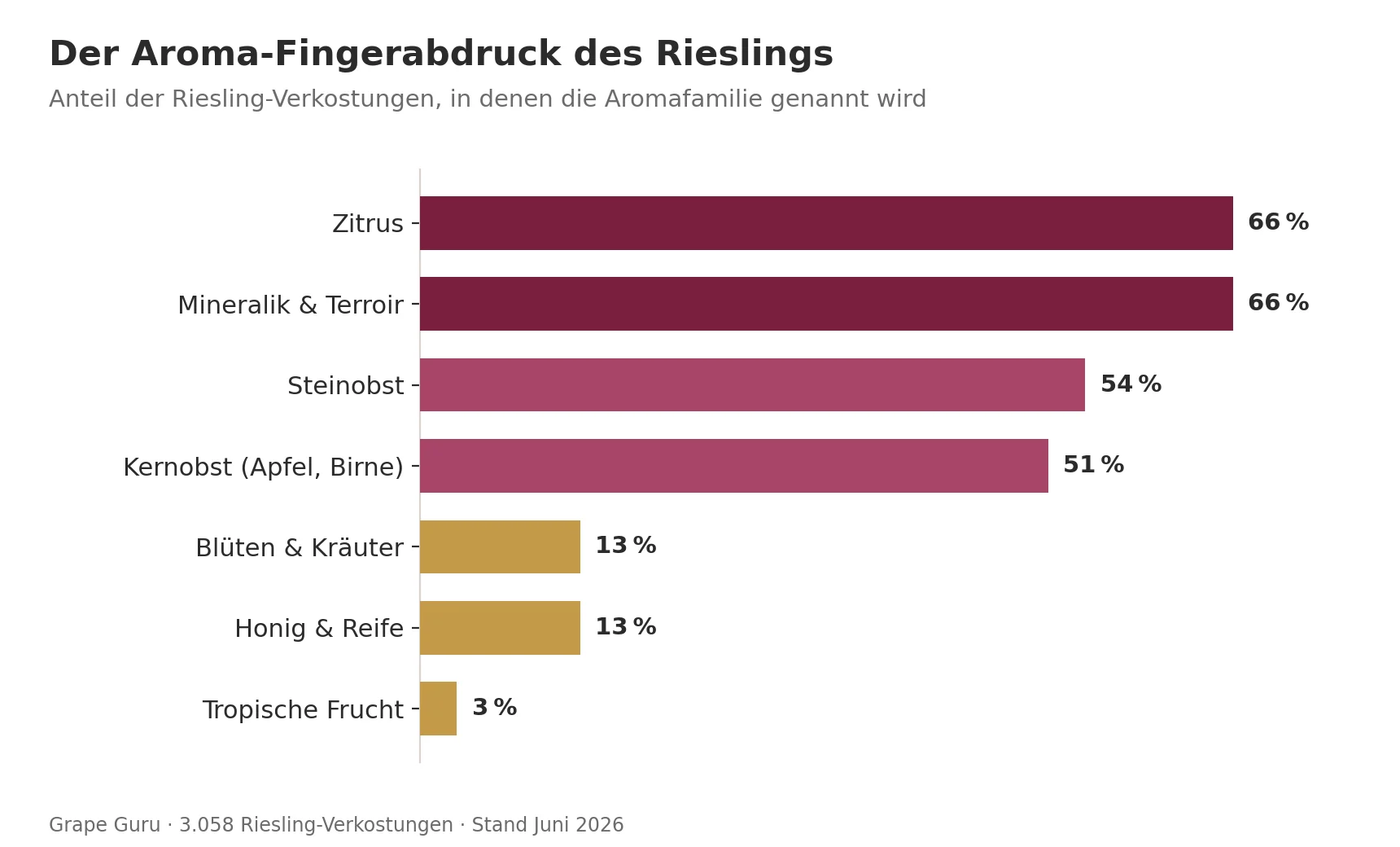
Two families dominate: citrus (lemon, lime, lemon zest) and minerality (flint, wet slate, the famous petrol note) appear in two thirds of all Riesling tastings each. Behind them come stone fruit (peach, apricot) and pome fruit (mainly green apple and pear) in a good half each.
What's most telling is what's missing: tropical fruits like mango or passion fruit are named by only 3% – Riesling is no warm southern wine, but lives on freshness, acidity and origin. Anyone after a wine with lots of exotic fruit is better served by Sauvignon Blanc.
How to recognise a great Riesling
Now it gets interesting. When you set the highest-rated Rieslings against the simpler ones, it becomes clear which aromas make a great Riesling – and which point to everyday bottles.
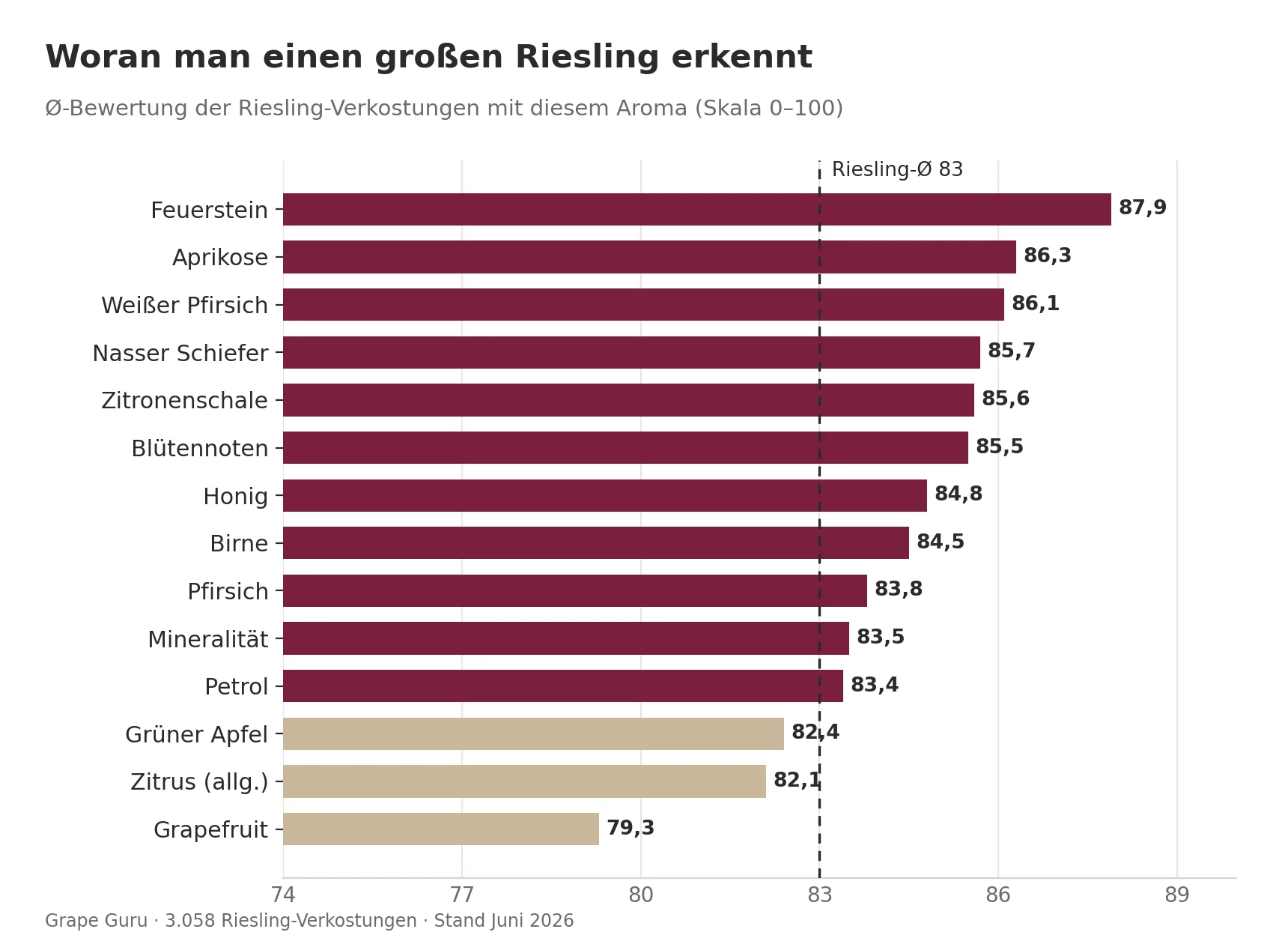
The top spots belong to minerality and stone fruit: Rieslings with notes of flint (avg. 87.9), apricot (86.3), white peach (86.1) and wet slate (85.7) are rated well above the Riesling average. Honey too – a sign of maturity or residual sweetness – ranks high.
At the bottom sit the aromas of young, simple Rieslings: green apple (82.4) and grapefruit (79.3). That's no coincidence. Green apple is typical of very young, lean wines that often still lack depth. Minerality and stone fruit, by contrast, are the language of origin and maturity – exactly what connoisseurs prize in a great Riesling.
In short: when a label or description mentions slate, flint, apricot or peach, there's a high chance there's more going on in the glass than in a pure "green-apple Riesling". Our guide How to taste wine like a pro shows how to spot these notes systematically.
Sweet or dry? What Germans drink – and what they rate highest
The most common question about Riesling also has the most surprising answer. It's drunk overwhelmingly dry: seven in ten rated Rieslings are dry, nine in ten dry or off-dry. The "dry reflex" is real.
Yet the highest ratings go, of all things, to the rare sweet examples.
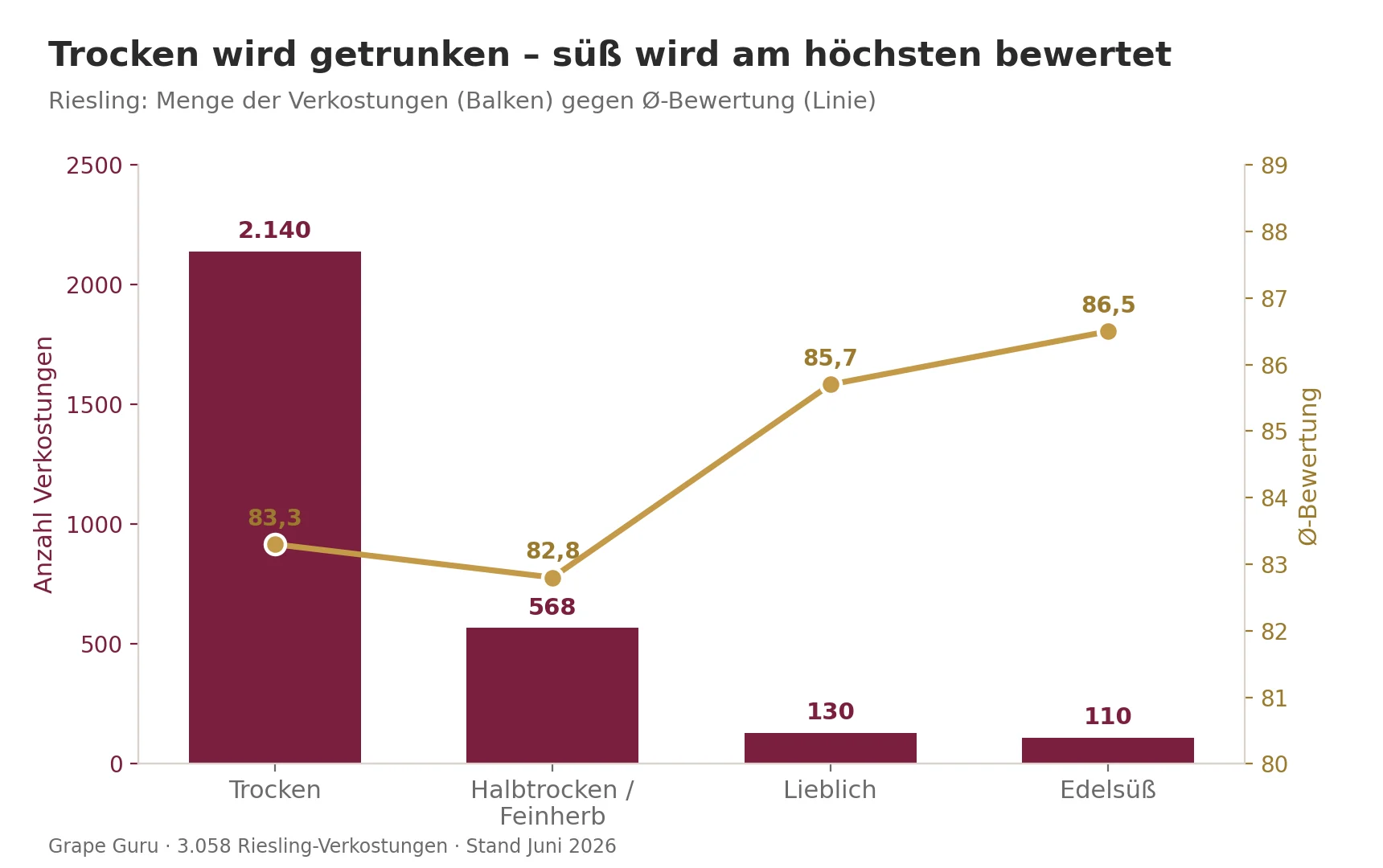
Nobly sweet Rieslings average 86.5 points, sweetish ones 85.7 – both clearly above the dry ones (83.3). That's the German tradition of noble sweetness in numbers: Auslese, Beerenauslese and ice wine are among the best the variety produces. People just rarely open them with dinner – they're the exception for a special moment.
An honest caveat: anyone opening a nobly sweet bottle usually does so deliberately for a special occasion – and probably rates a touch more generously. The sample size for the sweet styles is also smaller. So the finding is a clear tendency, not a law of nature. But it does dispel a prejudice: sweet Riesling isn't the cheap cliché, but often the finest version of the variety.
What does a good Riesling cost?
That leaves the question that matters at the shelf: how much do you actually have to spend? We set the prices people actually paid against the ratings.
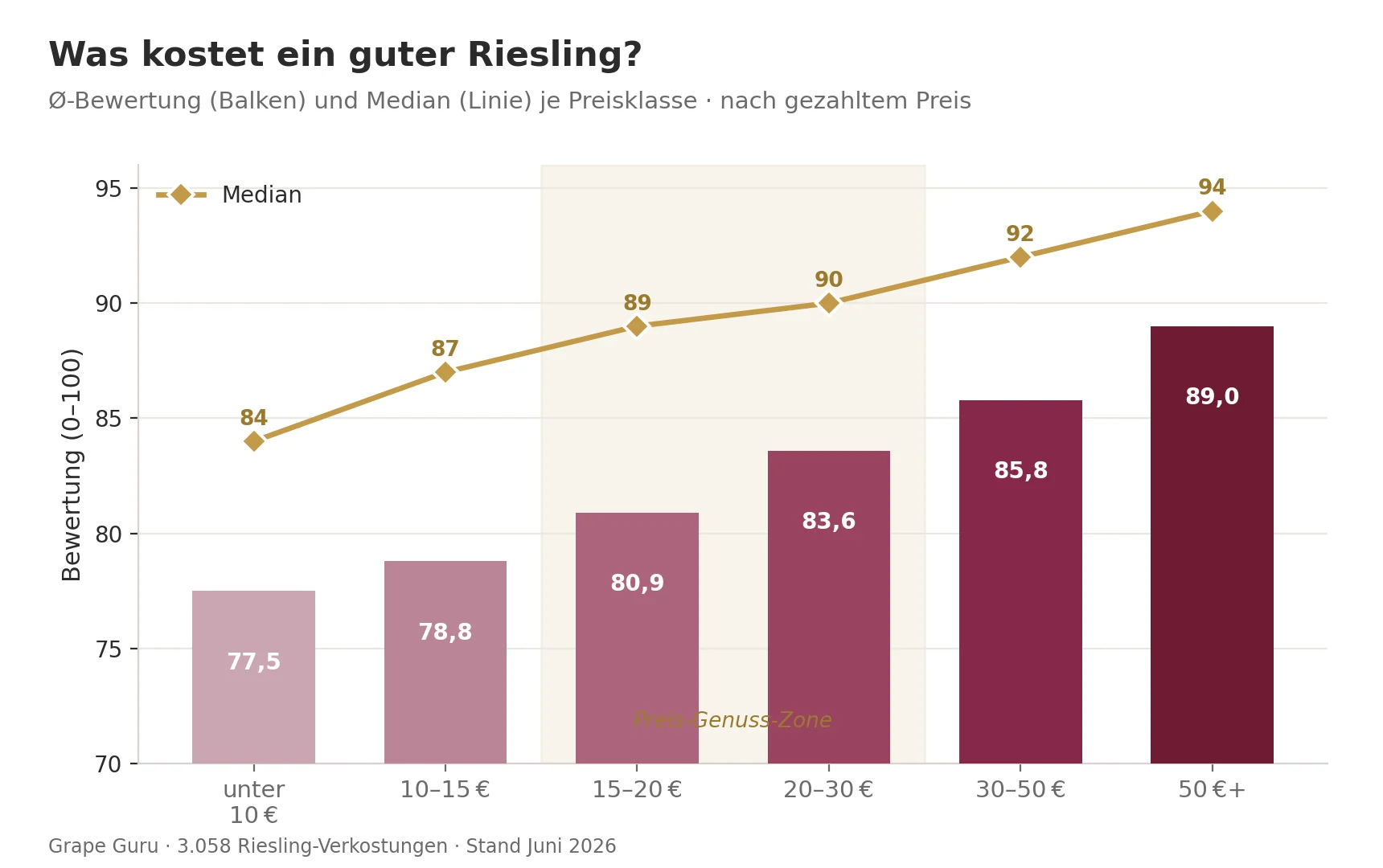
Unlike the average wine, the curve for Riesling doesn't flatten early – it keeps rising steadily. Even in the 10-to-15-euro band the typical Riesling (median) sits at 87 points, and from 15 to 20 euros at 89. Spend more and you keep gaining, but in smaller steps.
The practical rule of thumb: the price-enjoyment sweet spot lies between 15 and 25 euros. Below it you often already get a very decent wine; above it you're buying fine details for a special occasion. We looked in detail at whether expensive wine is worth it in Is expensive wine worth it? – and the short answer there holds for Riesling too: the biggest jump happens in the affordable range.
(The honest caveat applies here too: anyone paying 40 euros for a bottle expects more – part of the rise traces back to expectation, not the wine alone.)
Three things that surprised even us
- Riesling is no tropical wine. Exotic fruits like mango or passion fruit show up in only 3% of tastings. The variety lives on citrus, stone and acidity – not on sweet southern fruit.
- The petrol note is more common than you'd think. The notorious "petrol" aroma – a sign of maturity that divides opinion – is described in about one in twelve Rieslings. Those who like it find in it a marker of mature, characterful wine.
- Sweet beats dry on the score – even though almost nobody drinks sweet. The nobly sweet Rieslings are the rarest style in our data, but the highest-rated.
What to take away for your next Riesling purchase
- 15 to 25 euros is the range with the most enjoyment per euro – here you almost always get a genuinely good Riesling.
- Watch the description for slate, flint, apricot or peach – those are the aromas of the best wines. They especially mark the steep slopes of the Mosel.
- A "green-apple Riesling" is often young and lean – lovely for summer, but rarely the real showstopper.
- Dare to try a nobly sweet bottle once. It's not the old cliché, but often the best Riesling can do.
The easiest way to try it for yourself: scan the next Riesling bottle you have in hand with Grape Guru. In seconds you get an assessment, the right drinking window and food recommendations – so you never stand clueless at the shelf again.
Methodology
The basis is 3,058 Riesling tastings by 912 users of the Grape Guru app between November 2024 and June 2026 – part of an overall dataset of 24,001 tastings. Prices were available for 867 Riesling tastings, aroma descriptions for 1,426. Ratings are on a scale of 0 to 100.
Only single-varietal Riesling was counted as "Riesling"; distinct varieties such as Welschriesling or Schwarzriesling, as well as blends, were excluded. Variety names were consolidated into uniform labels before analysis. Aroma families group related individual aromas and are counted only once per tasting.
The analysis is not representative of the entire German population – it reflects the behaviour of wine-interested app users. Only anonymised, aggregated data was used.
A data analysis by Grape Guru, the AI-powered wine app. Source: anonymised user data, as of June 2026.
Frequently asked questions
What does Riesling taste like?
Riesling tastes above all of citrus (lemon, lime) and shows a pronounced minerality (flint, wet slate). On top of that come stone fruit such as peach and apricot, plus apple. Its high freshness and acidity are characteristic; tropical fruit is rare.
Is Riesling sweet or dry?
Most Rieslings are made dry – around 70% of the Rieslings rated in Grape Guru are dry, and about 90% are dry or off-dry. But there are also outstanding nobly sweet Rieslings (Auslese, Beerenauslese, ice wine) that rank among the highest-rated.
How much does a good Riesling cost?
A very good Riesling starts at around 15 euros. The best balance of enjoyment and price sits between 15 and 25 euros. Above that the quality keeps rising, but in smaller steps.
Why is Riesling so popular?
Riesling is the most-scanned and highest-rated grape variety in the Grape Guru app. Its combination of freshness, minerality and versatility – from bone-dry to nobly sweet – makes it the darling of German wine drinkers.
Enjoy wine smarter
Grape Guru makes wine knowledge come alive: Scan labels, discover food pairings, and build your wine collection.
You might also be interested in
Riesling
What does Riesling taste like? From bone-dry to nobly sweet: citrus and peach aromas, the famous petrol note – and which foods pair perfectly with it.
When Is Expensive Wine Worth It? 22,000 Tastings Give a Clear Answer
22,657 real tastings show: the biggest jump in enjoyment happens between 5 and 20 euros. After that, you pay a lot of money for very little more.
Sauvignon Blanc
What does Sauvignon Blanc taste like? Crisp white with grapefruit, lime, gooseberry and grassy notes – from the Loire to New Zealand, ideal with goat's cheese.
Mosel - Germany's Oldest Wine Region and Home of World-Famous Rieslings
Discover the Mosel: Europe's steepest vineyards, world-famous Rieslings from VDP wineries like Egon Müller, Dr. Loosen, and Prüm. Information on sites, wine styles, and visitor tips.
Woran erkennt man guten Wein?
Guten Wein erkennen: Die 4 Qualitätskriterien Balance, Länge, Komplexität und Typizität – plus Etiketten-Wissen, Weinfehler und Preis-Mythen im Check.
Wie verkostet man Wein wie ein Profi
Wein verkosten lernen: Mit der Sehen-Riechen-Schmecken-Systematik, Aromen-Training, Verkostungsnotizen und Übungen für zuhause verkostest du wie ein Sommelier.
The Best Wine App 2026: Vivino, CellarTracker, Oeni & Wine-Searcher Compared
Which wine app is the best? We compare Vivino, CellarTracker, Oeni, Wine-Searcher & Grape Guru on features and thousands of real store reviews.
Warum sind manche Weine so teuer? Den Wert edler Weine verstehen
Warum kosten manche Weine hunderte Euro? Die echten Kostentreiber von Lage bis Lagerzeit – und wann ein hoher Preis Qualität bedeutet oder nur Marketing.