

When Is Expensive Wine Worth It? 22,000 Tastings Give a Clear Answer
 By Johannes Quernheim · Wine Influencer & Content Creator
22,657 real tastings show: the biggest jump in enjoyment happens between 5 and 20 euros. After that, you pay a lot of money for very little more.
You're standing at the wine shelf, two bottles in hand. One costs 8 euros, the other 35. And you're wondering: does the expensive one really taste four times as good?
For the first time, we were able to dig into this question with real numbers. In Grape Guru, 2,834 wine lovers tasted and rated more than 22,000 wines – many of them with a price recorded. The result is surprisingly clear-cut.
The short answer
The biggest jump in enjoyment doesn't happen between 30 and 100 euros. It happens between 5 and 20 euros.
Switching from a very cheap bottle (under 5 euros) to one in the 10-to-20-euro range earns you, on average, around seven rating points. Keep spending more after that, and you do keep gaining – but for every additional point, you have to multiply the price.
Here's how the average ratings break down by price range (scale of 0 to 100):
| Price range | Avg. rating |
|---|---|
| under €5 | 79.1 |
| €5–10 | 82.6 |
| €10–15 | 85.3 |
| €15–20 | 86.4 |
| €20–30 | 88.0 |
| €30–50 | 89.0 |
| €50–100 | 90.2 |
| €100 and up | 93.7 |
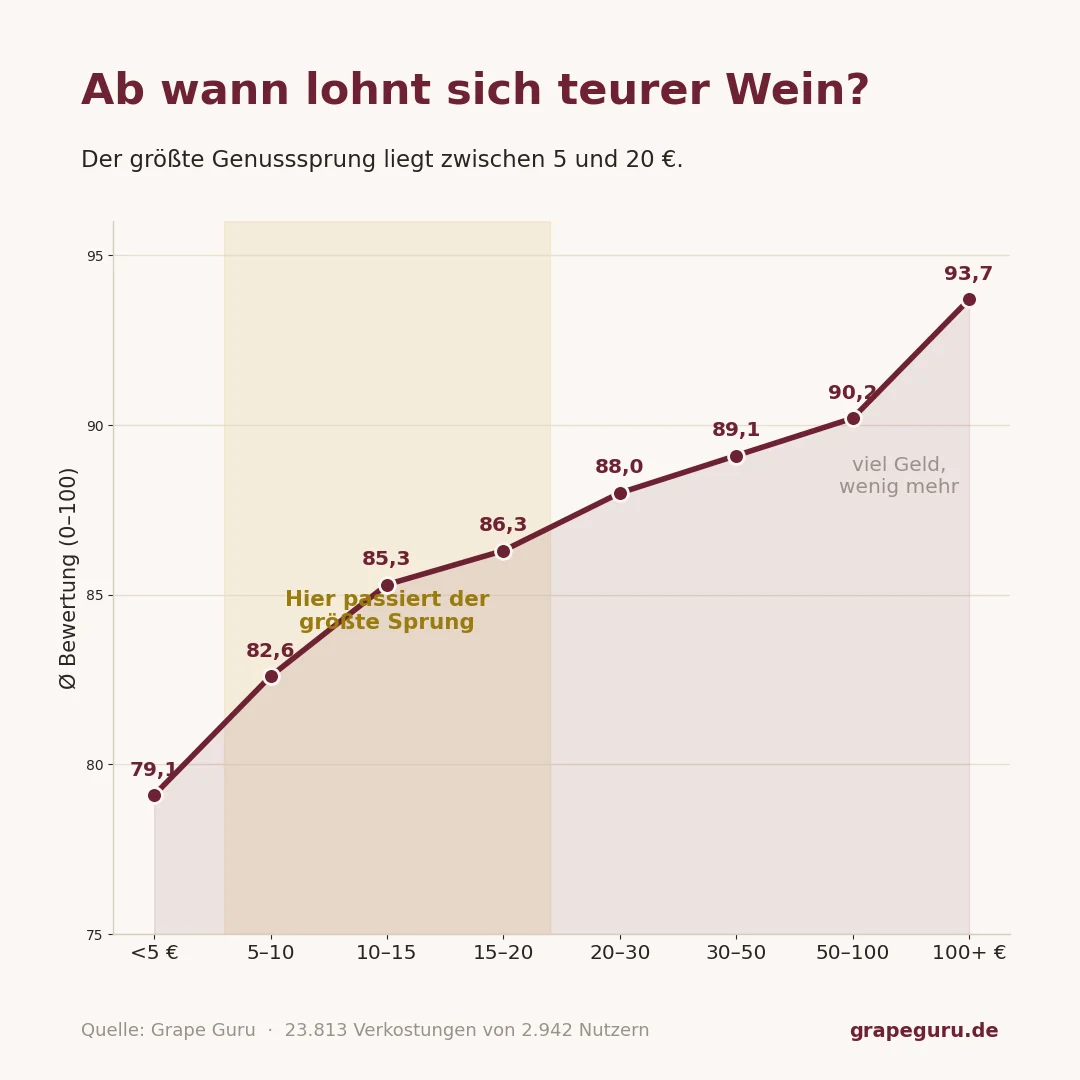
The curve climbs steeply early on – then flattens. Between a €15 bottle and an €80 one, there's an average gap of only about four points. Between a €4 and a €15 bottle, the gap is seven.
The practical rule of thumb: in the 10-to-20-euro range, you get by far the most enjoyment per euro. Above that, you're mainly buying fine details – lovely when the occasion is worth it, but no must for a good evening.
An honest caveat
These numbers aren't a blind tasting. When you open an expensive bottle, you often already expect more – and tend to rate it a little higher. So part of the increase comes down to expectation, not just the wine in the glass.
Even so, the finding holds up: even if you generously factor out that effect, the decisive jump in quality sits in the affordable range – not at the top. Expensive wine isn't "better for everyone." It's a question of occasion, not of basic kit.
France is the most expensive – but not the best
This becomes even clearer when you look at countries of origin. French wines are by far the most expensive in our tastings (an average of 40 euros per bottle) – more than twice as much as German ones (around 19 euros). The rating? Only barely a point higher (86.6 to 85.5). For that tiny edge, you pay double.
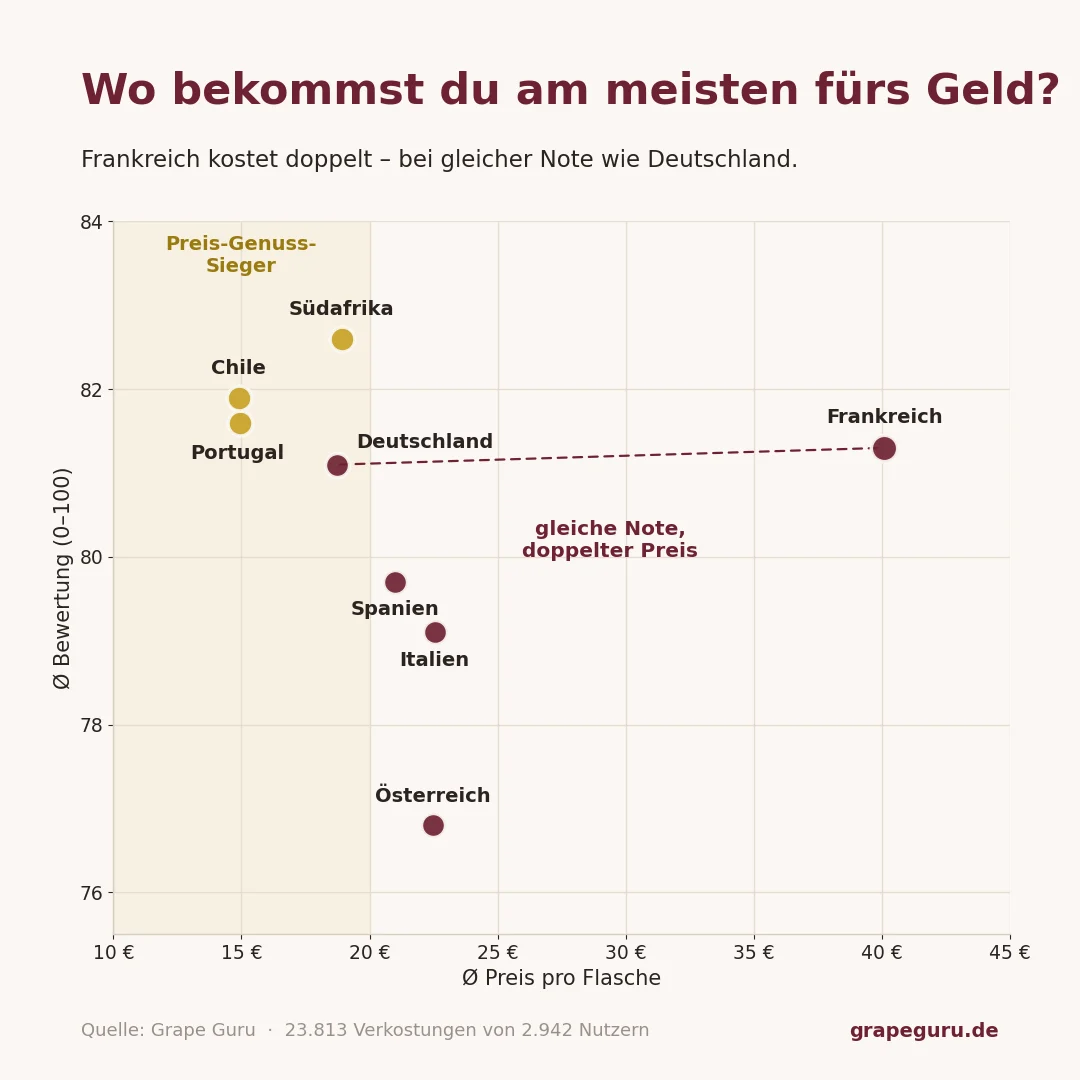
If you're after enjoyment per euro, you'll find it elsewhere. The most striking example: South Africa is even rated better than France (87.6 points) – and costs less than half on average (around 19 euros). Portugal (85.3 points at 15 euros) and Chile (84.9 at 15 euros) also deliver top scores at a small price. And German wine itself stands out brilliantly: the same league as Italy, but cheaper.
Three things that surprised even us
- The best tip for a small budget is called Muscat. At an average of €9.49, it's the cheapest grape variety of all – and at 86.2 points, rated above average. Hardly any wine gives you more enjoyment per euro.
- Champagne costs three times as much as a favorite Riesling – for barely any more points. At an average of over €66, Champagne is the most expensive category, yet it's rated barely better (87.6) than a good Riesling (87.0) at a third of the price. You're paying for the occasion, not for the points.
- White and red are equally popular – in the glass. White wine is tasted far more often, but red and white are rated practically the same (85.8 to 85.5). Sparkling wine takes the top spot.
And what does Germany like to drink most?
One grape stands out: Riesling. It's the most-scanned and most-tasted wine in the app – and at 87.0 points, also one of the best-rated. Behind it come Chardonnay and Spätburgunder (Pinot Noir).
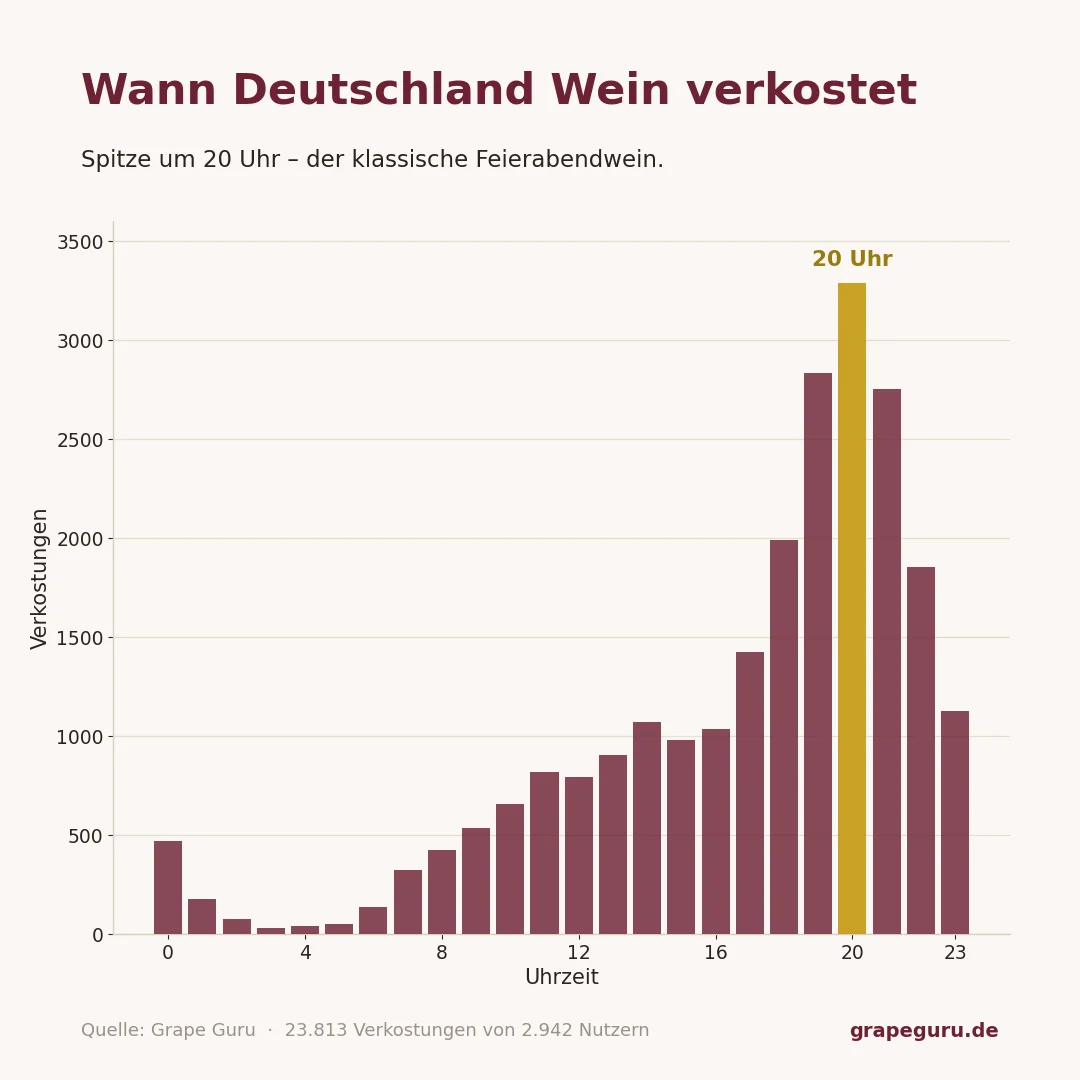
And when? Best of all after work: the number of tastings climbs steeply from 6 p.m. and peaks at 8 p.m.
What to take with you on your next shopping trip
- Skip the under-€5 bottle – that's where the disappointment is greatest.
- Between 10 and 20 euros, you almost always get genuinely good wine.
- Spending more is worth it for special occasions – not for every Tuesday evening.
- Look beyond France: South Africa, Portugal and Chile often offer more for your money – and German wine stands strong.
The easiest way to try this out yourself: scan the next bottle you have in hand with Grape Guru. In seconds you'll get an assessment, the right drinking window and food pairing recommendations – so you're never left clueless in front of the shelf again.
How much you should generally budget for a good bottle is something we go deeper into in the guide How much should I spend on wine? – and why some bottles run into triple digits at all is explained in Why are some wines so expensive?
Methodology
The basis is 22,657 rated wine tastings by 2,834 users of the Grape Guru app in the period from November 2024 to June 2026. Only tastings that were actually rated were analyzed; entries that were logged but not rated (around 6%) were excluded. Price data was available for just under 6,000 tastings. Ratings are made on a scale of 0 to 100. Grape and country names were consolidated into uniform labels before the analysis and reviewed by a sommelier. Price averages exclude outliers from €1,000 up.
The analysis is not representative of the entire German population – it reflects the behavior of wine-interested app users. Only anonymized, aggregated data was used.
A data analysis by Grape Guru, the AI-powered wine app. Source: anonymized user data, as of June 2026.
Frequently asked questions
Does good wine have to be expensive?
No. In our analysis of 22,657 tastings, ratings rise most sharply between 5 and 20 euros. Above that, the gain becomes small while the price climbs steeply.
What is the best price range for everyday wine?
10 to 20 euros. This is where the balance of quality and price is best – you almost always get genuinely good wine without paying extra for the fine details.
Which countries offer the best value for enjoyment?
South Africa, Portugal and Chile achieve high ratings at low average prices – South Africa is even rated better than the much pricier France. German wine, too, offers a very good balance of quality and price.
Is expensive wine worth it at all?
For special occasions, yes – above 20 euros you're mainly buying fine details and prestige. For everyday drinking, though, the added value over a 10-to-20-euro bottle is small.
Enjoy wine smarter
Grape Guru makes wine knowledge come alive: Scan labels, discover food pairings, and build your wine collection.
You might also be interested in
Wie viel sollte ich für Wein ausgeben? Ein Leitfaden zu Wert und Qualität
Wie viel Geld solltest du für eine Flasche Wein ausgeben? Warum 8-25 Euro der Sweet Spot sind, was Fixkosten ausmachen und welches Budget zum Anlass passt.
Warum sind manche Weine so teuer? Den Wert edler Weine verstehen
Warum kosten manche Weine hunderte Euro? Die echten Kostentreiber von Lage bis Lagerzeit – und wann ein hoher Preis Qualität bedeutet oder nur Marketing.
Supermarkt-Wein-Guide: So findest du verborgene Schätze
Guter Wein aus dem Supermarkt? Ja! So liest du Etiketten richtig, erkennst rote Flaggen und findest verlässliche Flaschen für 5 bis 15 Euro.
Riesling
What does Riesling taste like? From bone-dry to nobly sweet: citrus and peach aromas, the famous petrol note – and which foods pair perfectly with it.
Nebbiolo
What does Nebbiolo taste like? Tannic, age-worthy red from Piedmont with rose, cherry, leather and tar – the noble grape of Barolo and Barbaresco.
Woran erkennt man guten Wein?
Guten Wein erkennen: Die 4 Qualitätskriterien Balance, Länge, Komplexität und Typizität – plus Etiketten-Wissen, Weinfehler und Preis-Mythen im Check.
The Best Wine App 2026: Vivino, CellarTracker, Oeni & Wine-Searcher Compared
Which wine app is the best? We compare Vivino, CellarTracker, Oeni, Wine-Searcher & Grape Guru on features and thousands of real store reviews.
Why Riesling Is Germany's Favourite Wine – 3,058 Tastings Prove It
3,058 real Riesling tastings analysed: how Riesling tastes, how to spot a great one – and when the extra spend is actually worth it.