

The Best Wine App 2026: Vivino, CellarTracker, Oeni & Wine-Searcher Compared

Which wine app is the best? We compare Vivino, CellarTracker, Oeni, Wine-Searcher & Grape Guru on features and thousands of real store reviews.
You want a wine app. But which one? The App Store has dozens, and at first glance they look alike: scan a label, identify the wine, something with ratings. Look closer, though, and most of these apps are doing something quite different from what you might think – they want to sell you wine.
We took a look at the five best-known wine apps: Vivino, CellarTracker, Oeni, Wine-Searcher – and our own app, Grape Guru. For the comparison, we didn't just lay the features side by side; we also analyzed thousands of real reviews from the Apple App Store, Google Play and portals like Trustpilot. The result is surprisingly clear.
Full disclosure: Grape Guru is one of the apps being compared – we're not hiding that. That's exactly why we rely on publicly verifiable sources (store reviews, tests, trade media) rather than on claims. Where another app is a better fit than ours, we say so.
The short answer
In short: the best wine app depends on what you want. For the lowest price on a particular bottle, Wine-Searcher leads the field; for huge English-language collections, CellarTracker – and if you want to enjoy, understand and learn about wine, without ads and without sales pressure, Grape Guru is the best choice, especially for German and European wine.
Because there are two kinds of "wine apps":
-
Apps that want to sell you something. Vivino is an online wine retailer with a scanner wrapped around it. Wine-Searcher is a price search engine that sends you to the cheapest retailer. Oeni treats your collection like a stock portfolio. With these apps, you're not just a user – you're also a potential buyer.
-
Apps that help you enjoy. They answer questions like: What kind of wine is this? When should I drink it? What goes with it? How do I learn more? – without trying to push a bottle on you at the end.
If you're looking for an app that doesn't sell you wine, shows no ads, and helps you really understand and enjoy wine, then Grape Guru is the best choice – especially for German and European wine. If, on the other hand, you mainly want the lowest price for a particular bottle, Wine-Searcher is the right tool. And anyone who wants to manage a huge collection with market values and professional critic scores in English is in good hands with CellarTracker.
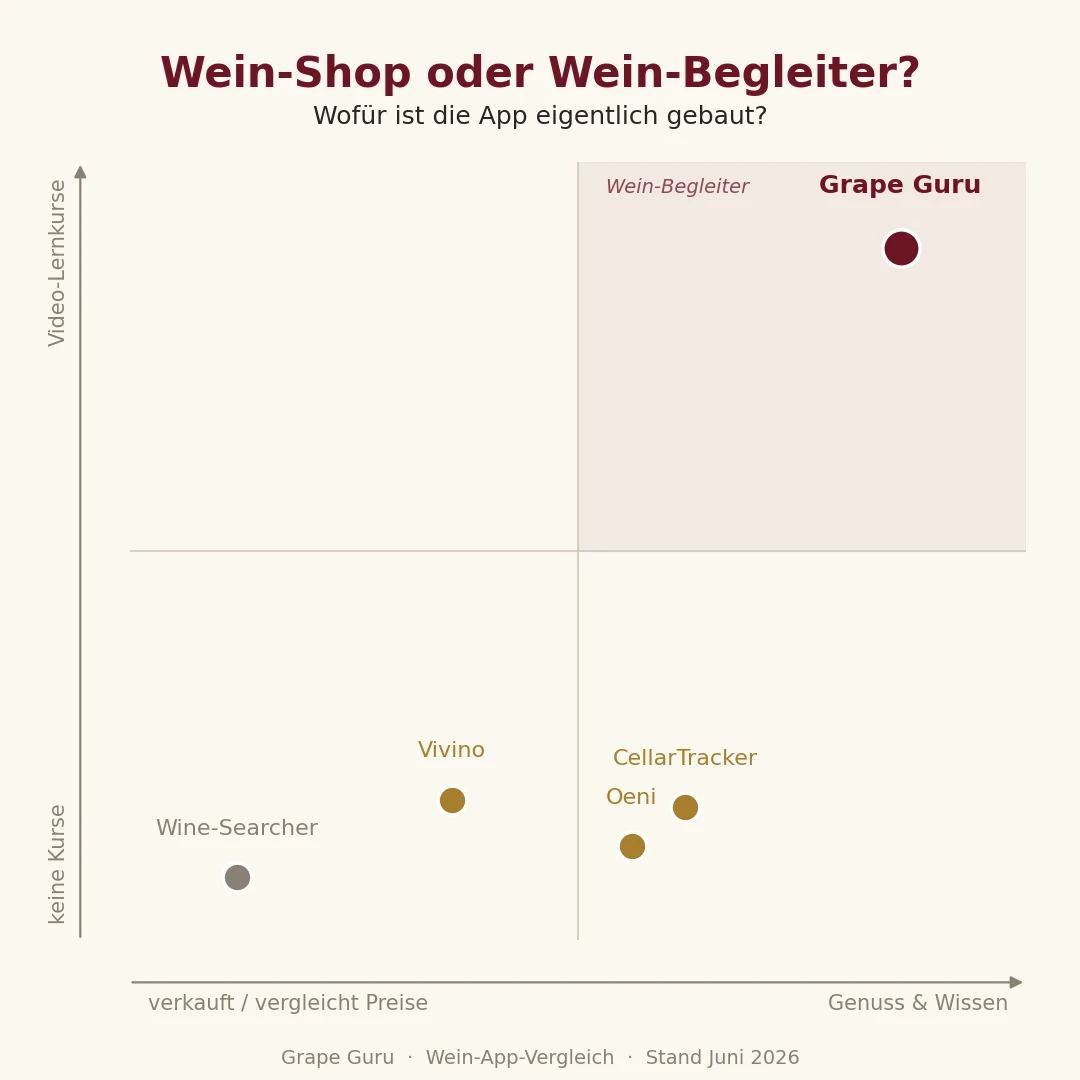
Two kinds of wine apps – and why that matters for you
The renowned wine magazine wein.plus compiled nearly 30 wine apps in one overview – and deliberately excluded one category: the apps of individual wine retailers, with which you can only order their own range. The logic behind this is sound: a sales platform with a scanner is something different from a true wine app.
This is exactly where the crux lies. When an app earns money from wine sales, it isn't neutral. It has an interest in you buying – not necessarily in you enjoying the wine you already have at home. That's not a moral problem, but it shapes the product: What gets shown to you prominently? What suddenly costs extra? What is the app actually built for?
The five apps at a glance
| App | What it's actually built for | Origin / market |
|---|---|---|
| Vivino | Rating and buying wine (online marketplace with 65–70 million users) | International |
| Wine-Searcher | Comparing prices and finding the cheapest retailer | International (New Zealand) |
| CellarTracker | Managing large collections, market values & professional critic scores | International (English-language) |
| Oeni | Managing a wine cellar and tracking the collection's value as an investment | France |
| Grape Guru | Understanding, enjoying and learning about wine – without sales | Germany (Europe) |
What do the real reviews say?
Vivino – the marketplace with the scanner image
Vivino, with 65 to 70 million downloads, is by far the largest wine app in the world – and at the same time an online wine retailer. Its own slogan in the German Play Store is honest: "Buy the best wine." Vivino earns money on every wine sold through the app (around 15% commission).
When it comes to scanning labels, Vivino is technically strong – wine expert Jancis Robinson calls it the benchmark in her scanner test. The problem shows up elsewhere, and it's impossible to miss in the more recent reviews: Vivino has moved previously free features behind a paywall and serves non-paying users full-screen ads. Long-time users are reacting with frustration – the gist: an app you've been feeding ratings into for years suddenly makes you pay for basic functions. In the German Play Store, users additionally report that the free wine cellar was capped at 20 bottles – anyone with more is expected to buy Premium.
Important context: an app's overall average across all its years can stay high while the current reviews turn sour. Apple and Google blend old and new ratings together – Vivino sits at 4.6 stars in the German Play Store (and around 4.7 in the Apple App Store), but on around 231,000 reviews collected over many years. A lifetime average like that easily masks a fresh wave of dissatisfaction. That's exactly what's happening with Vivino right now.
Wine-Searcher – not really a wine app at all, but a price search engine
Wine-Searcher does one thing, and it does it really well: comparing prices. Every night the app gathers millions of prices from over 55,000 retailers worldwide. You scan a label and see where the bottle is cheapest. In the stores it stands out with high averages (around 4.8 stars from nearly 17,000 reviews in the App Store, 4.77 from around 7,000 on Google Play) – among power buyers and collectors who know what they're looking for.
But: it's a shopping tool, not a wine companion. Its label recognition scores only middling in independent tests (Jancis Robinson: 7/10, "if price information is your main need, this is the right app"). Courses, learning content or real food pairing? Not here. And on Trustpilot, complaints are piling up that Wine-Searcher lists retailers without genuine vetting – users report dubious or fraudulent shops appearing via the platform. Top-notch for pure price research. As an app for experiencing wine, unsuitable.
CellarTracker – the strongest competitor, but English and matter-of-fact
CellarTracker is the most serious point of comparison – and we say that without beating around the bush. 20 years of community data, over 13 million reviews (including professional critics), more than 8 million users, a tracked collection value of 21 billion dollars. The app was completely modernized in 2024/25 and enriched with AI. Anyone who wants to manage a large, valuable collection will find the deepest trove of data in the industry here. The new app is also strongly rated in the stores (4.91 stars from around 2,500 reviews on Google Play).
Where CellarTracker falls short – and where Grape Guru wins: it is through and through English-language and internationally oriented, with no real focus on German wine culture, VDP classifications or regional depth. There are no wine courses, no videos, no playful learning elements – CellarTracker is a data and management tool, not a learning companion. And through its Wine-Searcher integration it pulls in price and market-value data – the wine-as-an-asset mindset is present here too.
Oeni – the wine cellar as an investment
The French app Oeni (Google Play: 4.64 from over 9,400 reviews) is solidly made: wine cellar management, a 3D cellar, drinking-maturity forecasts, food pairing and – its unique selling point – investment tracking. Oeni updates the market value of your bottles monthly and shows you your "capital gains" per bottle. Here, wine becomes an asset class.
Recurring criticisms come up in the reviews: the wine database doesn't recognize everything automatically (users have to add a lot manually), key functions sit behind the paywall, and there are bugs. There's no learning content or courses. Anyone who views their collection as an investment is in the right place here – anyone who simply wants to enjoy and understand wine, less so.
Grape Guru – the app for everyone who wants to enjoy wine rather than buy it
And that's exactly the gap Grape Guru fits into. What our users write in the stores sums it up – in essence: "Everything is geared toward enjoying wine, not just comparing wines." Another user, long in search of a working wine cellar tracker, writes in essence that most apps fail to recognize half of all wines – whereas with Grape Guru, every wine gets recognized.
That comes down to the technology: Grape Guru is the only AI-native wine scanner in the comparison. Instead of matching a label against a rigid database (as Vivino, CellarTracker, Oeni and Wine-Searcher do), an AI analyzes each label individually – in around four seconds, even for rare wines. On top of that there's a digital wine cellar with a drinking-window traffic light (green = perfect now, yellow = wait, red = drink soon), AI food pairing via photo or text, and short video wine courses with Johannes, one of Germany's best-known wine creators.
Three things set Grape Guru fundamentally apart from the rest: no wine sales, no ads, German privacy standards. Its own App Store text puts it openly: developed by three wine lovers from Germany, with no investors and no advertising. For free you get the unlimited scanner, a wine cellar for up to 25 bottles, basic courses and the complete gamification system. In the Apple App Store, Grape Guru sits at 4.8 stars, on Google Play at 4.9 – that's still a young, small rating base, but the direction is right.
The direct feature comparison
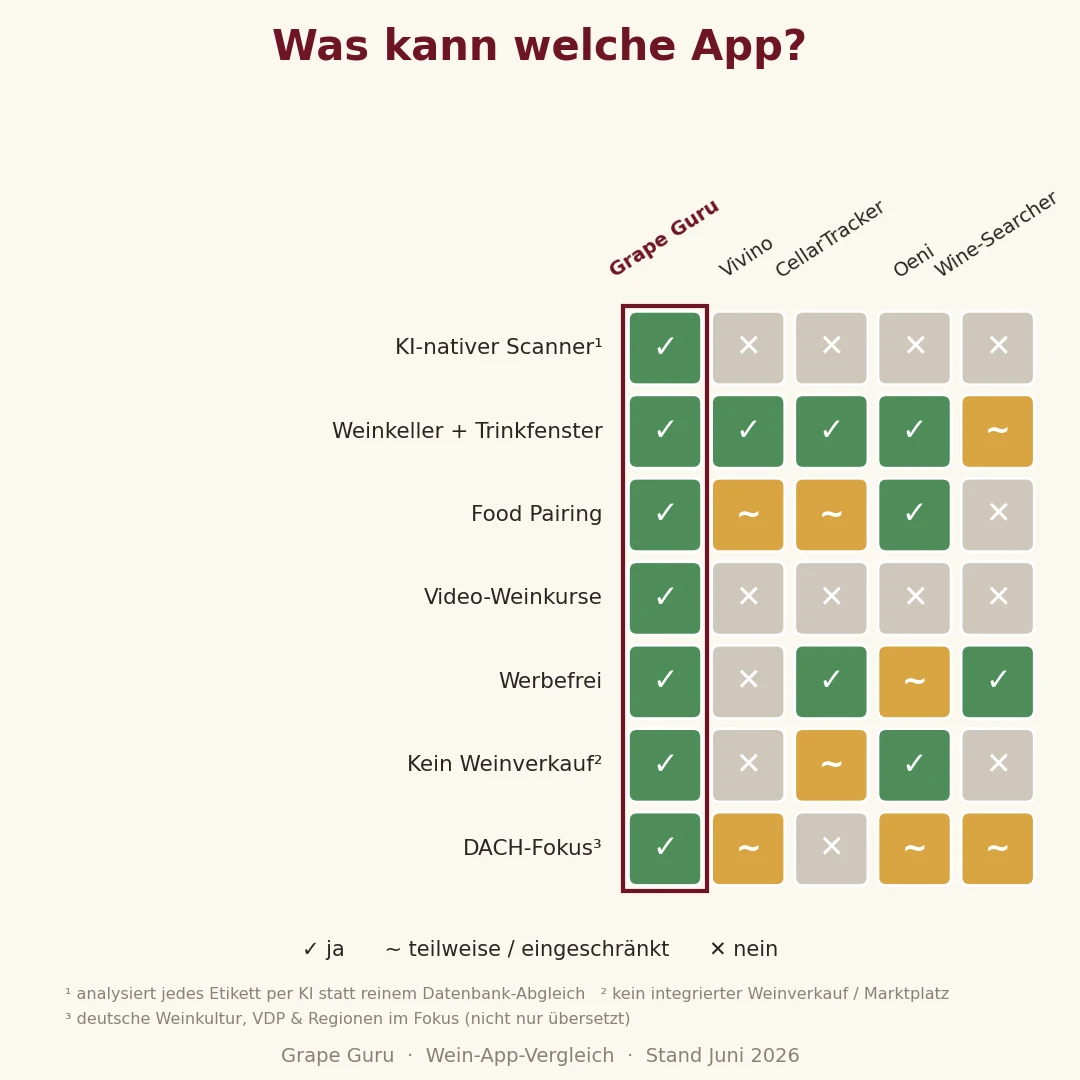
We compared the seven features that matter for enjoying and understanding wine:
| Feature | Grape Guru | Vivino | CellarTracker | Oeni | Wine-Searcher |
|---|---|---|---|---|---|
| AI-native scanner¹ | ✅ | ❌ | ❌ | ❌ | ❌ |
| Wine cellar + drinking window | ✅ | ✅ | ✅ | ✅ | ~ |
| Food pairing | ✅ | ~ | ~ | ✅ | ❌ |
| Video wine courses | ✅ | ❌ | ❌ | ❌ | ❌ |
| Ad-free | ✅ | ❌ | ✅ | ~ | ✅ |
| No wine sales² | ✅ | ❌ | ~ | ✅ | ❌ |
| Made in Germany / European focus³ | ✅ | ~ | ❌ | ~ | ~ |
¹ analyzes each label via AI instead of pure database matching · ² no built-in wine sales / marketplace · ³ German & European wine culture, VDP & regions in focus (not just translated). ✅ yes · ~ partial/limited · ❌ no.
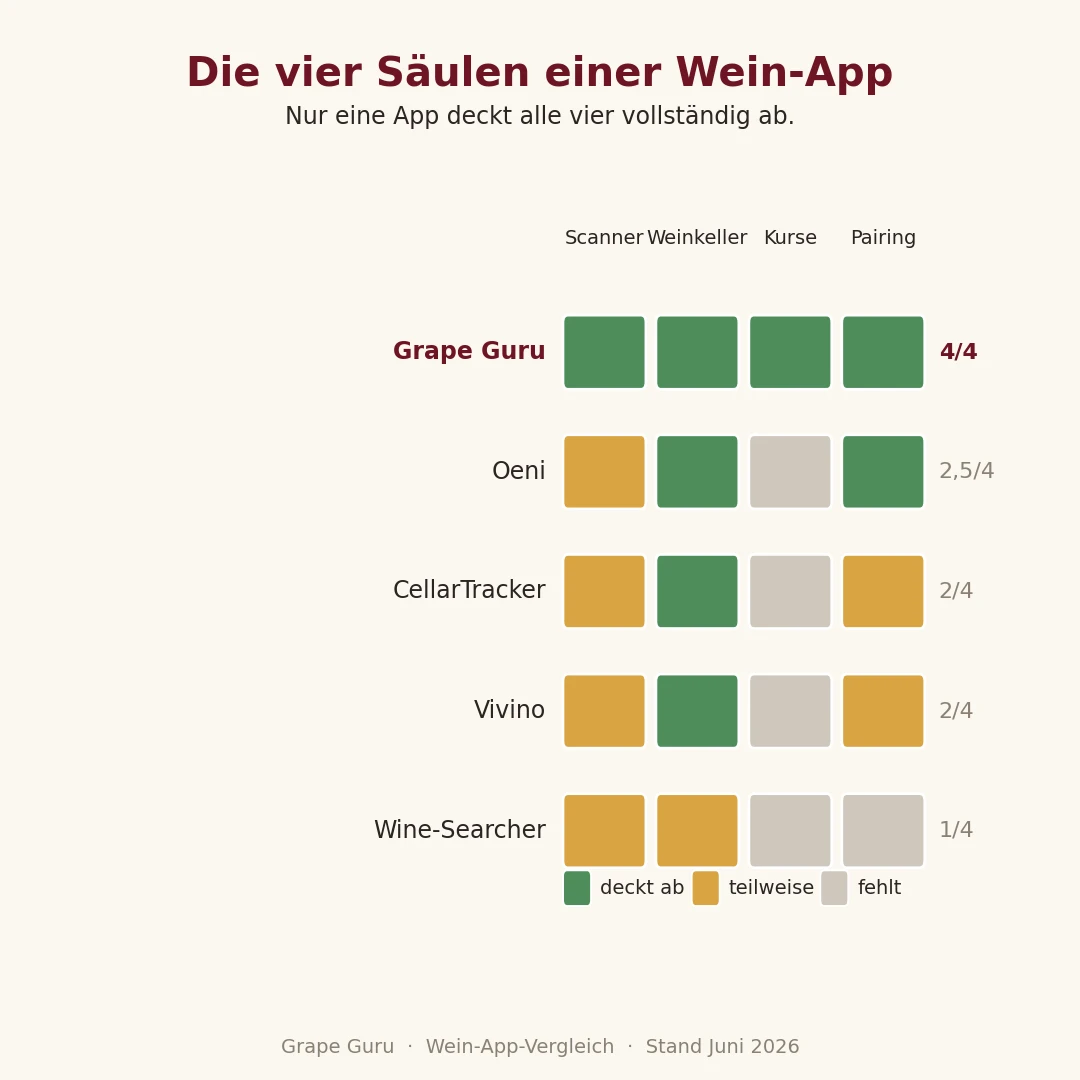
Boil that down to the four pillars that make up a fully featured wine app – scanner, wine cellar, courses, food pairing – and the clearest picture emerges: only one app covers all four completely.
The store ratings at a glance
| App | Apple App Store (iOS) | Google Play | Downloads (Android) | Business model |
|---|---|---|---|---|
| Grape Guru | 4.8 ★ (young base) | 4.9 ★ (64 reviews) | 1,000+ | Freemium subscription, no sales |
| CellarTracker | high, new app* | 4.91 ★ (≈2,500 reviews) | 64,000+ | Donations/contributions + subscription features |
| Wine-Searcher | ≈4.8 ★ (≈16,900 reviews) | 4.77 ★ (≈7,000 reviews) | 1.3 million+ | Retailer listings + PRO subscription |
| Oeni | ≈4.7 ★ (≈490 reviews) | 4.64 ★ (≈9,400 reviews) | 440,000+ | Freemium subscription + value tracking |
| Vivino | ≈4.7 ★ (large base) | 4.6 ★ (≈231,000 reviews) | 10 million+ | Marketplace (~15% commission) + Premium |
As of June 2026. Google Play figures from store and AppBrain data (Grape Guru & Vivino: German Play Store). Apple App Store figures for Grape Guru (4.8) and Vivino (around 4.7) from the App Store; *CellarTracker is highly rated as a new app, but Apple blocks automated reading of the overall rating – please check directly in the App Store on your device. Apple figures are also country-specific. App Store ratings fluctuate constantly and can't be compared one-to-one due to very different review counts and app ages: Vivino's 4.6 in the Play Store rests on around 231,000 reviews collected over the years – a lifetime average like that easily masks the fact that the current reviews come out markedly more critical. Grape Guru's figures rest on a small, young base so far. What's meaningful, then, is less the bare number than the direction of the new reviews.
Which wine app suits whom?
There isn't one best app for everyone – it depends on what you want:
- You want to buy wine cheaply and find the best price → Wine-Searcher. That's what it's built for, and it does it better than all the others.
- You want to manage a huge collection with market values and professional critic scores – and English doesn't bother you → CellarTracker. The deepest trove of data in the industry.
- You view your wines as an investment → Oeni. Investment tracking is the centerpiece here.
- You want a huge community and to buy directly in the app → Vivino. Just know that you'll be navigating between ads and paywalls along the way.
- You want to understand, enjoy and learn about wine – without ads, without anything being sold to you, and ideally with a focus on German and European wine → Grape Guru. Scanner, wine cellar, food pairing and video courses in one app, with a focus on German and European wine culture.
Conclusion
Most of the well-known wine apps are, at their core, sales or pricing tools: Vivino earns money on wine sales, Wine-Searcher sends you to a retailer, Oeni calculates the portfolio value of your bottles. That's legitimate – but it just isn't a "wine companion." CellarTracker is the strongest true competitor, but it remains an English-language management tool with no learning content.
Anyone looking for a wine app that helps them understand wine, drink it at the right moment, pair it perfectly and learn more step by step – completely without ads and without sales pressure – will find in Grape Guru the most well-rounded solution currently available for German and European wine. Start for free, try it yourself, and you'll notice the difference on your very first scan.
How much a good bottle should actually cost – and when expensive wine is really worth it – is shown by our data report When is expensive wine worth it? based on more than 23,000 real tastings. And how to spot a good wine in the glass is explained in our guide How do you recognize a good wine?
Methodology & Transparency
This comparison relies on publicly available sources, as of June 2026: the App Store and Google Play pages of the five apps, statistics and review portals (including AppBrain, JustUseApp, Trustpilot), trade media (wein.plus, Jancis Robinson) and the providers' official information. Reviews were summarized in substance, not quoted verbatim.
App Store ratings are country-specific and change constantly; they can't be compared directly due to very different review counts and app ages. The feature assessment ("covered / partial / missing") is an evaluation by Grape Guru based on each app's advertised and tested functions. Grape Guru is itself one of the apps being compared – we have therefore deliberately relied on verifiable facts and named the strengths of the other apps where they exist.
A wine app comparison by Grape Guru, the AI-powered wine app from Germany.
Frequently asked questions
Which wine app is the best?
It depends on what you want. For pure price comparison, Wine-Searcher is the best; for large English-language collections, CellarTracker. If you want to enjoy, understand and learn about wine – with no ads and nothing being sold to you – Grape Guru is the best choice, especially for German and European wine, because it's the only one that combines an AI scanner, wine cellar, food pairing and video courses in a single app.
What is the best alternative to Vivino?
Vivino is essentially an online wine retailer and has recently moved features behind a paywall and introduced ads, which has annoyed many long-time users. If you're looking for an ad-free alternative with no sales pressure, Grape Guru is a great fit; if you mainly want market values and collection management, CellarTracker is.
Which wine app shows no ads and doesn't sell wine?
Grape Guru shows no ads and has no built-in wine sales. CellarTracker and Wine-Searcher are also ad-free, but they pursue different priorities (collection management and price comparison with retailer listings, respectively).
Which wine app is best for German and European wines?
Grape Guru is the only app in the comparison built from the ground up for German and European wine culture – with VDP classifications, regional depth and privacy that meets German standards. Vivino, Oeni and Wine-Searcher are translated but internationally oriented; CellarTracker is English-language and US/international. So if German and European wines are your focus, Grape Guru is the natural choice.
Which wine app is best for managing a wine cellar?
For very large collections with market values, CellarTracker leads the field, closely followed by Oeni (including investment tracking). Grape Guru offers a digital wine cellar with a drinking-window traffic light that tells you which wine to open next – ideal if you want not just to manage your wines but to enjoy them at their best moment.
Which wine app has wine courses?
Among the major wine apps, only Grape Guru offers structured video wine courses – short, Instagram-style lessons presented by a well-known German wine creator, rounded out with interactive quizzes. Vivino, CellarTracker, Oeni and Wine-Searcher have no course content.
Enjoy wine smarter
Grape Guru makes wine knowledge come alive: Scan labels, discover food pairings, and build your wine collection.
You might also be interested in
When Is Expensive Wine Worth It? 22,000 Tastings Give a Clear Answer
22,657 real tastings show: the biggest jump in enjoyment happens between 5 and 20 euros. After that, you pay a lot of money for very little more.
Woran erkennt man guten Wein?
Guten Wein erkennen: Die 4 Qualitätskriterien Balance, Länge, Komplexität und Typizität – plus Etiketten-Wissen, Weinfehler und Preis-Mythen im Check.
Wie viel sollte ich für Wein ausgeben? Ein Leitfaden zu Wert und Qualität
Wie viel Geld solltest du für eine Flasche Wein ausgeben? Warum 8-25 Euro der Sweet Spot sind, was Fixkosten ausmachen und welches Budget zum Anlass passt.
Wie verkostet man Wein wie ein Profi
Wein verkosten lernen: Mit der Sehen-Riechen-Schmecken-Systematik, Aromen-Training, Verkostungsnotizen und Übungen für zuhause verkostest du wie ein Sommelier.
Warum sind manche Weine so teuer? Den Wert edler Weine verstehen
Warum kosten manche Weine hunderte Euro? Die echten Kostentreiber von Lage bis Lagerzeit – und wann ein hoher Preis Qualität bedeutet oder nur Marketing.
Naturwein verstehen: Die Grundlagen
Naturwein einfach erklärt: Was Vin Naturel von Bio-Wein unterscheidet, wie er schmeckt und wie du den perfekten Einstieg findest – ohne Fehlkauf.
Why Riesling Is Germany's Favourite Wine – 3,058 Tastings Prove It
3,058 real Riesling tastings analysed: how Riesling tastes, how to spot a great one – and when the extra spend is actually worth it.