


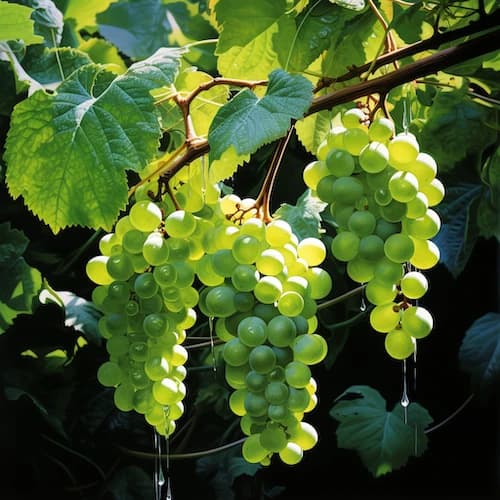


Austria's White Wine Ambassador with Peppery Character
Grüner Veltliner is more than just a grape variety – it is Austria's liquid flagship. With its unmistakable peppery kick and lively freshness, it has evolved from a regional insider tip to an internationally celebrated white wine. Whether as an uncomplicated summer wine or as a complex rarity from the Wachau, the "Grüvee" – as connoisseurs affectionately call it – surprises with an impressive stylistic range, from light and crisp to powerful and age-worthy.
Flavour Profile & Characteristics
What makes Grüner Veltliner so special is its unmistakable pepper note – a spicy element that you will find in this form in hardly any other variety. In the glass it typically shows a pale yellow with greenish reflections, already announcing the wine's freshness.
On the palate, a lively, almost electrifying acidity greets you, making the wine incredibly refreshing. The aromatics are dominated by crisp green apple and zesty lime, underpinned by that characteristic peppery spice. Depending on origin and ageing, fresh herbal notes such as cut grass or garden herbs join in, along with a distinctive minerality recalling damp stones or flint.
The body varies greatly depending on the growing area and winemaking method. Simple Grüner Veltliners from the Weinviertel present themselves as light and accessible – perfect thirst-quenchers with moderate alcohol around 11.5–12.5%. Wines from the prestigious terraced vineyards of the Wachau, however, show considerably more substance and power. Here, Smaragd wines with 13–14% alcohol can develop impressive complexity and structure.
As high-quality Grüner Veltliners age, a fascinating honey note develops and hints of roasted nuts appear. The pepper spice becomes more subtle while the minerality becomes even more present. The acidity remains the backbone of the wine, ensuring that even ten-year-old Veltliners still taste remarkably fresh.
Origin & History
Grüner Veltliner is an autochthonous Austrian variety genetically related to Traminer. Its origin was long unclear until DNA analyses in the 2000s revealed that the variety is a natural cross between Traminer and a wild vine now extinct. The name "Veltliner" probably derives from the South Tyrolean valley of Valtellina, although the variety is now barely found there.
Grüner Veltliner is mentioned in historical records from the 18th century, but its true renaissance came only in the last 40 years. What was once considered a simple Heurigen wine has been developed by Austrian growers, through drastic yield reductions and careful cellar work, into a world-class white wine.
Today Austria is, with over 13,000 hectares under vine, the absolute centre of Grüner Veltliner. The variety dominates especially in Lower Austria, where it occupies around 50% of the vineyard area. Smaller holdings are also found in Slovakia, the Czech Republic and Hungary, but nowhere else does the variety reach the quality it achieves in its Austrian homeland.
Viticulture & Terroir
Grüner Veltliner is a robust and adaptable variety that copes well with various climatic conditions. It thrives best, however, in a moderately continental climate with cool nights during the ripening phase – exactly what Lower Austria offers. The variety buds relatively late, making it less susceptible to late frosts, and ripens mid-season, usually late September to early October.
In terms of soils, Grüner Veltliner proves surprisingly versatile. On the fertile loess soils of the Weinviertel it produces accessible, fruit-forward wines with charming lightness. On the primary-rock terraces of the Wachau, by contrast, complex, mineral wines with enormous ageing potential emerge. Particularly prized are sites on gneiss and amphibolite, which lend the wines their characteristic stone-fruit note and spice.
The most important growing regions are the Wachau with its spectacular steep sites on the banks of the Danube, the Kremstal and Kamptal with their diverse soils ranging from loess to sand to primary rock, and the Weinviertel as Austria's largest contiguous growing area. Each region shapes the character of Grüner Veltliner in its own way: Wachau for power and minerality, Kremstal for elegance and spice, Kamptal for balance and complexity, Weinviertel for freshness and drinkability.
Wine Styles & Variants
The stylistic diversity of Grüner Veltliner is impressive. The entry level is formed by light, young wines aged in stainless steel that impress with their lively fruitiness. These "Classics" are perfect everyday wines and summer refreshments.
A step above are the village and single-vineyard wines, where terroir and origin take centre stage. These wines often spend several months on the fine lees, lending them more structure and creaminess. Some growers also experiment with spontaneous fermentation or skin contact, giving the wines additional texture and complexity.
The absolute pinnacle is formed by the Smaragd wines from the Wachau – powerful, concentrated growths from the finest sites. These wines are often aged in large wooden barrels or even small barriques, though very restrainedly, so as not to mask the varietal freshness. With 13–14% alcohol they have considerably more substance and can comfortably age for 10–15 years.
An exciting speciality are the reserve wines vinified according to the strict criteria of the Traditionsweingüter Österreich. These may not be sold until 18 months after the harvest and already show impressive complexity in youth.
In cuvées, Grüner Veltliner usually plays a subordinate role, as its character is so pronounced. Occasionally you will find it in Gemischter Satz – traditional Viennese wines from several varieties vinified together.
Typical Aromas
Primary Aromas (from the grape)
Green apple is the leitmotif of Grüner Veltliner – crisp, fresh, sometimes almost as if you had bitten into a Granny Smith. In cooler sites this note becomes even more pronounced, while warmer locations produce somewhat riper apple aromas.
Lime and citrus provide the refreshing zestiness. Depending on ripeness, the aromatics range between fresh lime zest and ripe lemon. In the Wachau you often also find nuances of grapefruit.
Pepper note – the unique selling point! This spicy component, recalling white pepper, is genetically encoded in the variety. On primary-rock soils it becomes particularly intense, while on loess it appears somewhat more discreet.
Fresh herbs such as cut grass, nettles or garden herbs give the wine its green characteristic. On the nose this sometimes recalls a walk through a spring meadow.
Minerality presents itself as damp stones, flint or wet slate – particularly pronounced in wines from primary-rock soils. This salty, almost smoky quality is what makes high-quality Grüner Veltliners so fascinating.
Secondary Aromas (from winemaking)
Yeasty notes develop in wines that have spent longer on the fine lees. This adds more creaminess and a brioche-like character to the wine without compromising its freshness.
Buttery nuances can appear in some wines, especially when malolactic fermentation has been carried out – though this is rather the exception, as most growers prefer to retain the lively malic acidity.
Vanilla and toast are found in wines aged in new oak barrels. Most top producers, however, opt for large, old wooden barrels or Stockinger casks, which give the wine structure without dominant wood notes.
Tertiary Aromas (from ageing)
Honey notes develop in high-quality Grüner Veltliners after 5–8 years of bottle ageing. The wine turns more golden, the fruit notes become more subtle, but a fascinating complexity emerges.
Dried fruits and nuts – in older vintages (10+ years), aromas of dried pear, candied citrus and toasted almonds emerge. The pepper note softens but the minerality remains present.
Petrol notes can appear in very old, age-worthy Grüner Veltliners, similar to matured Riesling. This is not a fault but a sign of noble maturity.
Grüner Veltliner is among the most age-worthy Austrian white wines. While simple qualities should be drunk within 1–2 years, Smaragd wines and Große Gewächse can comfortably age for 10–15 years and develop in the process an impressive tertiary aromatics without losing their characteristic freshness.
Food Pairing
Perfect Combinations
Wiener Schnitzel is the classic combination par excellence. The lively acidity of Grüner Veltliner cuts through the breadcrumbs and refreshes the palate, while the peppery note pairs perfectly with the tender, juicy texture of the veal. Choose a medium-bodied Veltliner from the Kamptal for this quintessentially Austrian combination.
Asian cuisine – particularly Thai, Vietnamese or sushi – harmonises fantastically with Grüner Veltliner. The herbal notes of the wine echo the aromatics of coriander, lemongrass and ginger, while the acidity plays with sweet and sour sauces and the peppery character interacts with chilli. A light, fresh Veltliner from the Weinviertel is ideal here.
Asparagus is a notoriously difficult partner for wine, but Grüner Veltliner masters this challenge with ease. Its green, herbal notes suit the vegetable perfectly, whether served with Hollandaise sauce or classically with melted butter. Choose a Veltliner with medium body from the Kremstal.
Fish and seafood – from grilled fish to scallops and freshwater crayfish – find an outstanding companion in Grüner Veltliner. The mineral saltiness of the wine underscores the marine character, while the acidity lifts the flavours. For pan-fried fish with more herby sauces, reach for a Wachauer Smaragd with more substance.
Grüner Veltliner is one of the most versatile food wines of all – from light summer cooking to a substantial main course, there is a suitable style for almost every occasion. Feel free to experiment – this variety is culinarily very forgiving and continually surprises with new successful combinations!