


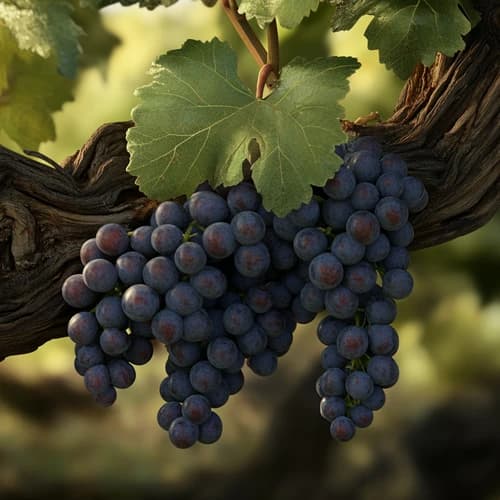


The Powerful Secret Weapon from Bordeaux
Petit Verdot is the grape variety that works behind the scenes yet achieves great things. Originally from Bordeaux, it was long underestimated as a blending partner — but anyone who has ever tried a single-variety Petit Verdot understands its true power. With its deeply dark colour, intense tannins, and unmistakable violet aroma, this variety brings a structure and complexity to the glass that is without equal.
Flavour Profile & Character
Petit Verdot is a wine for those who like it bold. The variety produces wines of exceptional intensity and structure. In the glass, Petit Verdot presents itself in such a dark violet that it appears almost black — a visual preview of the power to follow.
On the palate, massive but noble tannins dominate at first. These are firm and grippy, never rough or aggressive, but of velvety quality. The high acidity gives the wine freshness and tension that harmonises perfectly with the fruit richness and full-bodied body. The flavour profile is complex: dark berry fruit meets spicy notes, underlined by a characteristic violet note that makes Petit Verdot so unmistakable.
In cooler regions Petit Verdot can develop a certain austerity and shows more herbal and pepper notes. In warmer growing areas the variety unfolds its full potential: the tannins become riper, the fruit more concentrated and sweeter, while the floral notes become even more present. Alcohol content typically lies between 13 and 15 percent, contributing to the full-bodied texture.
With increasing age, Petit Verdot wines develop a fascinating complexity. The primary fruit notes recede somewhat as aromas of leather, tobacco, and spice move to the foreground. The tannins round off and integrate harmoniously into the overall picture.
Origin & History
The home of Petit Verdot lies in the Bordelais, the famous wine region in south-west France. The name "Petit Verdot" — translated as "little green one" — is somewhat misleading, as it does not refer to berry size but to the late ripening of the grape. Historically, the variety was often still green (unripe) in Bordeaux when the other varieties had already been harvested.
For centuries Petit Verdot played an important if modest role in Bordeaux. In the classic Bordeaux blends it rarely made up more than 5 percent, but it brought decisive qualities: additional tannins for structure, intense colour, and a spicy complexity. Châteaux such as Margaux and Palmer valued the variety for precisely these qualities.
In the 20th century Bordeaux plantings initially declined — the late ripening made Petit Verdot a risky choice. But with climate change and warmer summers the variety is experiencing a renaissance. At the same time, producers in warmer regions worldwide have discovered the potential of Petit Verdot for single-variety wines.
Today Petit Verdot is grown successfully above all in California, Australia, Spain, and Chile — regions where the variety can achieve full ripeness and show its impressive personality.
Cultivation & Terroir
Petit Verdot is a demanding variety that needs warmth and patience. It ripens very late — often 2 to 3 weeks after Cabernet Sauvignon — and therefore requires a long, warm growing season. In cool or changeable years it can be difficult to bring Petit Verdot to full ripeness, which in the past contributed to its limited spread.
The variety prefers well-drained, gravelly, or loamy soils. In Bordeaux it performs best on the gravelly terraces of the Médoc and on the limestone soils of Saint-Émilion. The vines are vigorous and yield moderate crops, leading to concentrated grapes with thick skins — ideal for tannic, deeply coloured wines.
Key Wine Regions:
In California, particularly in Napa Valley and Paso Robles, Petit Verdot has found a second home. The warm days and cool nights allow a long ripening period with preserved acidity. Many producers here now make single-variety Petit Verdots of impressive quality.
In Spain the variety is increasingly planted in La Mancha and Toro, where the continental climate provides sufficient warmth. In Australia Petit Verdot is found primarily in McLaren Vale and Margaret River, where Mediterranean conditions prevail.
In Chile and Argentina too the variety is gaining importance, particularly in higher-altitude vineyards where daytime temperatures are high enough for ripening while cool nights preserve acidity.
Wine Styles & Variants
Traditionally Petit Verdot was used as a blending partner. In classic Bordeaux blends it brings structure, colour, and complexity. Together with Cabernet Sauvignon, Merlot, Cabernet Franc, and Malbec it forms the basis for some of the world's greatest red wines. Its proportion is usually small — 2 to 8 percent — but its influence is clearly perceptible.
In recent decades, however, increasingly many producers have recognised the potential of single-variety Petit Verdot. These wines are powerful and concentrated, with massive structure and impressive ageing ability. They are usually aged in oak barrels, often with a high proportion of new barrels, to further refine the tannins and create additional complexity.
Ageing typically takes place over 12 to 24 months in French or American oak. American oak brings sweeter vanilla notes and additional spice, while French oak emphasises the floral tones and provides finer integration.
In more modern approaches some producers experiment with different ageing methods — from the use of amphorae to minimal-intervention approaches. These wines often show rawer, more direct fruit and allow the terroir to come through more strongly.
As a blending partner, Petit Verdot pairs excellently with Cabernet Sauvignon (adds extra structure), Merlot (increases complexity and spice), and Syrah (reinforces the peppery notes).
Typical Aromas
Primary Aromas (from the grape):
The most characteristic aroma of Petit Verdot is violet — an intense, almost perfumed blossom note that is as pronounced in barely any other variety. This floral element gives the wine an elegant, almost exotic dimension.
Blackberry and black plum dominate the fruit spectrum. These dark berries are ripe and concentrated, often with a slight wildness recalling Mediterranean maquis scrubland. In cooler regions notes of blackcurrant can also appear.
Black pepper is a typical spice aroma that gives Petit Verdot spice and complexity. This peppery note is amplified by the terroir and is especially present in younger wines.
Leather often develops relatively early and gives the wine a rustic, earthy character. These notes can range from delicate and supple to more robust suede-like textures.
In warmer climates additional notes of cocoa and sweet tobacco appear, lending the variety extra depth.
Secondary Aromas (from winemaking):
Ageing in oak barrels brings vanilla and toast notes that interweave with the dark fruit. When American oak is used, coconut and dill aromas can also appear.
Malolactic fermentation and fine-lees ageing can develop buttery brioche notes that lend the wine creaminess and additional texture.
Tertiary Aromas (from ageing):
Petit Verdot is exceptionally age-worthy — high-quality wines can comfortably age for 10 to 20 years. Over time, aromas of dried tobacco, cedarwood, and truffle develop. The initial fruit shifts towards prune and fig.
The tannins fully integrate over the years, creating a silky texture. The floral violet notes often remain present for a remarkably long time, giving aged Petit Verdot a particular elegance.
Food Pairing
Perfect Combinations:
Grilled Ribeye Steak with Pepper Crust: The massive tannins and high acidity of Petit Verdot are tailor-made for fatty, grilled beef. The peppery notes in the wine echo the seasoning on the meat, while the tannins cut perfectly through the fat. A match made in heaven.
Braised Lamb Ragout with Herbes de Provence: The intensity of slowly braised lamb effortlessly handles the power of Petit Verdot. The spicy, almost Mediterranean notes in the wine harmonise beautifully with rosemary, thyme, and bay leaf in the ragout. The violet notes add a surprising floral component.
Age-Friendly Hard Cheese: Aged Manchego, old Gouda, or Parmigiano Reggiano are ideal companions. The saltiness and umami notes of the cheese make the fruit notes in the wine shine, while the tannins are tamed by the fat of the cheese.
Game with Plum Chutney: The wild notes in the wine find their perfect partner in venison or wild boar. A sweet-sour plum chutney additionally showcases the plum aromas in the Petit Verdot and creates a complex, multi-layered flavour experience.
Important: Avoid overly light dishes or delicate fish dishes — the power of Petit Verdot would overwhelm them. Think bold, spicy, and characterful, and you'll be on safe ground.