


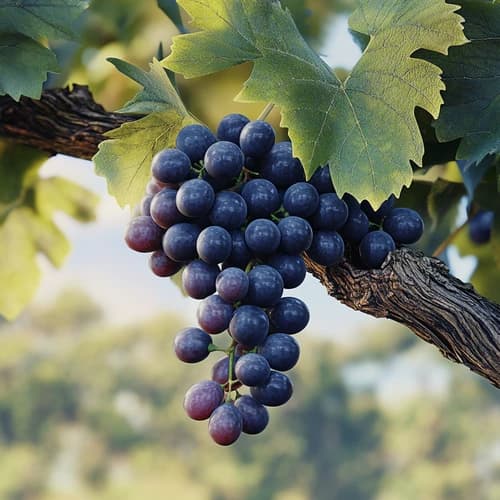


Introduction
Gamay is the ultimate fun grape for everyone who loves red wine but has no desire for heavy tannins. This charming French variety is the heart of Beaujolais and enchants with its carefree fruitiness, lively acidity and a drinkability that is second to none. While Gamay long stood in the shadow of its Burgundian neighbours Pinot Noir and Chardonnay, it is experiencing a renaissance today – and for very good reason.
Flavour Profile & Characteristics
Gamay is the embodiment of uncomplicated drinking pleasure. In the glass the variety typically presents a bright ruby red with violet reflections – a visual delight from the outset. The first sip reveals a burst of juicy fruit: red cherries, strawberries and raspberries dominate, accompanied by delicate violet notes and sometimes a hint of white pepper.
What makes Gamay so special is the balance between lively acidity and velvety-soft tannins. The wines are never heavy or alcoholic, but remain elegant and highly drinkable. Depending on the winemaking method, the profile can differ considerably: Beaujolais Nouveau, the famous primeur, shows pronounced banana and bubblegum aromas from carbonic maceration. The more serious Cru Beaujolais, on the other hand, develop more structure, mineral notes and can even display subtle earthy or floral nuances.
In cooler sites and on granite soils, wines with firm acidity and crystal-clear fruit are produced. Warmer areas yield fuller, more generous versions that nevertheless never lose Gamay's typical lightness. With age, high-quality Gamay wines develop more complex aromas of dried roses, mushrooms and undergrowth, yet always retain their youthful freshness.
Origin & History
The history of Gamay is closely linked with Burgundy – though not in a positive sense. The variety originally comes from the village of Gamay in the Côte-d'Or département. In the 14th century, Gamay was widespread even in Burgundy's most prestigious sites, until Duke Philip the Bold issued a momentous edict in 1395: he had all Gamay vines in Burgundy uprooted, calling them "très mauvais et très déloyal" (very bad and very disloyal). The reason was simple – Gamay produced higher yields than Pinot Noir but was deemed qualitatively inferior for the noble Burgundian terroirs.
This ban proved to be a blessing for Beaujolais. The adjacent southern region, with its granite soils, offered ideal conditions for Gamay, and the variety found its true home here. Over the centuries, Beaujolais winemakers perfected the cultivation and vinification of this grape until Gamay became the undisputed king of the region.
Today Beaujolais, with over 20,000 hectares under vine, is the absolute centre of Gamay production. The variety accounts for around 98% of the planted area here. Beyond Beaujolais, Gamay is found in the Loire (especially in Touraine), in Bugey, in the Jura and in Switzerland, where it is valued as a variety in its own right or in cuvées with Pinot Noir. In total, around 36,000 hectares of Gamay are cultivated worldwide – a modest area that nevertheless produces wines of great character.
Viticulture & Terroir
Gamay is an early-ripening variety that prefers cool to temperate climates. It is relatively frost-resistant and copes well with the sometimes harsh conditions of its main growing regions. The grape buds early, which makes it susceptible to late spring frosts, and ripens approximately two weeks before Pinot Noir – a decisive advantage in cooler years.
The ideal terroir for Gamay is undoubtedly granite. The granite soils of Beaujolais are low in organic matter, well-drained and force the vines to root deeply. The result is wines with lively acidity, mineral structure and precise fruitiness. On the more calcareous soils of southern Beaujolais, fuller, rounder wines are produced, though often with less finesse. In the Loire, Gamay also thrives on slate soils and calcareous terroirs, leading to somewhat different styles – often slightly earthier and spicier.
The most important wine regions for Gamay are the ten Cru sites of Beaujolais: Brouilly, Côte de Brouilly, Chénas, Chiroubles, Fleurie, Juliénas, Morgon, Moulin-à-Vent, Régnié and Saint-Amour. Each Cru expresses its own character – from the elegant, perfumed wines of Fleurie and Chiroubles to the structured, long-lived bottles from Moulin-à-Vent and Morgon. In the Loire region, Touraine and Anjou are important Gamay areas, while Switzerland – particularly the Valais and Geneva – also produces high-quality Gamay wines.
Wine Styles & Variants
The stylistic diversity of Gamay is greater than many would expect. Best known is certainly Beaujolais Nouveau – the primeur that comes to market every year on the third Thursday of November. These wines are made by carbonic maceration, a method in which whole, intact grapes ferment in a sealed tank under a CO2 atmosphere. The result is fresh, fruity, light wines with typical banana, bubblegum and candy aromas. They are intended for immediate enjoyment and should be drunk within a few months.
Beaujolais and Beaujolais-Villages represent the next quality tier. These wines are often produced using a combination of traditional fermentation and carbonic maceration and show more structure than the Nouveau. They remain fruit-forward and accessible, but with somewhat more depth, and can be cellared for one to two years.
Cru Beaujolais are the serious representatives of the Gamay world. These wines come from the ten best sites and are typically fermented traditionally, often partly or entirely without carbonic maceration. They show more complex aromas, more tannic structure and an impressive ageing potential of 5–10 years, occasionally even longer. Particularly Morgon and Moulin-à-Vent can, with increasing maturity, approach Burgundian Pinot Noir.
In the Loire, Gamay is often produced as a single varietal, but also blended in cuvées with Pinot Noir, Cabernet Franc or Grolleau. These wines are generally drier and leaner than their Beaujolais counterparts, with a pronounced minerality. In Switzerland, both light, fresh versions and denser, more structured wines are produced depending on the region and winemaker philosophy.
Typical Aromas
Primary Aromas (from the grape)
The primary aromas of Gamay are a true cabinet of fruit. Red cherries top the list – fresh, juicy and lively, as if you had just bitten into a perfectly ripe sweet cherry. Strawberries join in, particularly in wines from cooler sites or higher-elevation vineyards. This strawberry note can range from fresh and bright to cooked strawberry jam, depending on ripeness and winemaking.
Raspberries complete the red-berry trio and bring a lightly tart freshness. In warmer years or sunnier sites, blackberries and blackcurrants can also appear, lending the wine a touch more depth. A characteristic note of violets or generally floral accents make Gamay wines – especially in Cru sites like Fleurie and Chiroubles – unmistakable, lending the wine a perfumed, elegant element.
Terroir plays a decisive role: on the granite soils of Beaujolais the aromas remain crystal clear and precise with a mineral undertone. On more calcareous soils the fruit aromas become more generous and rounded, sometimes with a hint of ripe plum.
Secondary Aromas (from winemaking)
The vinification method has an enormous influence on the aromatic profile of Gamay. With carbonic maceration, typical for Beaujolais Nouveau and many simpler Beaujolais, characteristic banana aromas develop – sometimes almost like banana extract. These are joined by notes of candy, cherry bubblegum and sometimes even nail-polish remover (ethyl acetate) if the process was too intense.
With traditional fermentation and skin maceration, spicier notes develop: white pepper, herbs and sometimes a light clove note may appear. Winemakers working with whole-bunch fermentation but longer maceration achieve wines with more structure and earthy undertones such as mushrooms or forest floor.
Ageing in oak barrels is not uncommon for Cru Beaujolais, though it remains mostly discreet. Here, subtle notes of vanilla, cinnamon or mocha can appear without masking the wine's fruity nature.
Tertiary Aromas (from ageing)
While simple Beaujolais wines should be drunk young, high-quality Cru Beaujolais develop a fascinating complexity with age. After 3–5 years, aromas of dried rose petals, tea, leather and undergrowth emerge. The fresh cherry fruit transforms into notes of dried cherries or cherry compote.
Particularly impressive in ageing are wines from Moulin-à-Vent and Morgon, which after 8–10 years can take on Burgundian characteristics – with aromas of truffle, forest floor, wild mushrooms and a silky texture. These aged Gamay wines surprise even experienced wine lovers and prove that the variety is capable of far more than just uncomplicated drinking pleasure.
That said, Gamay is not a variety for eternal cellaring. Even the best Cru Beaujolais typically reach their peak after 10–15 years and should be drunk reasonably promptly thereafter. The lively acidity that is so refreshing in youth remains an important component even in aged wines and prevents them from becoming heavy or oxidative.
Food Pairing
Gamay is a true all-rounder at the table – its versatility makes it the perfect companion for a wide range of dishes.
Perfect Combinations
Charcuterie and French classics: There is hardly a better combination than a chilled Beaujolais alongside a platter of air-dried sausage, pâté, terrine or rillettes. The fresh acidity and light tannins of Gamay cut through the fat, while the fruitiness perfectly complements the savoury aromas of the charcuterie. For Coq au Vin or Boeuf Bourguignon, a more structured Cru Beaujolais is a fantastic choice.
Poultry and pork: The medium body structure of Gamay harmonises beautifully with poultry dishes – whether herb-roasted chicken, duck with cherry sauce or turkey. It also pairs excellently with pork chops, roast pork or even grilled pork belly slices. The wine's fruitiness plays wonderfully with the slightly sweet notes of pork.
Mushroom dishes: The earthy notes found especially in aged Cru Beaujolais make Gamay the ideal partner for mushroom dishes. Whether porcini risotto, sautéed chanterelles, mushroom ragout or truffle pasta – the combination is a dream. The mineral structure and moderate tannins perfectly complement the umami-rich aromas of the mushrooms.
Cheese: For soft cheeses such as Brie, Camembert or Époisses, a Beaujolais Villages is ideal – the creamy texture and light acidity of the cheese harmonise with the fruitiness of the wine. Gamay also pairs well with light goat's cheeses or medium-aged Comté, as it accompanies elegantly rather than overwhelming with intense tannic structures.