

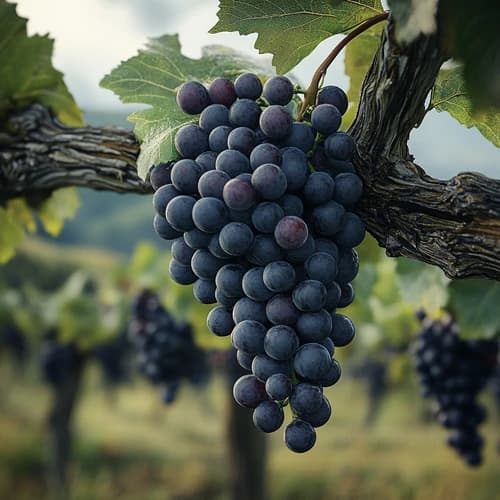


Touriga Nacional
Introduction
Touriga Nacional is considered Portugal's most important and prestigious red wine grape variety – the secret queen of the Douro Valley. With its extraordinary intensity, complex floral aromas of violets and roses and impressive structure, it produces both legendary Port wines and increasingly highly regarded dry reds. Although it remains relatively unknown outside Portugal, Touriga Nacional counts internationally among the great grape varieties with immense quality potential.
Flavour Profile & Character
Touriga Nacional presents itself in the glass in deep, impenetrable purple to violet – a visual hint at the enormous concentration. The aroma profile is breathtakingly complex and intense: the nose is immediately captivated by intoxicating floral notes – violet, roses, iris and lavender form a perfumed bouquet that makes the variety unmistakable. Beneath lie dark, concentrated fruit aromas: juicy blackberries, blackcurrants, ripe plums and blueberries.
With increasing aeration, spicy notes of liquorice, sweet spices such as cinnamon and cloves, as well as mineral undertones unfold. Depending on ageing, aromas of dark chocolate, espresso, cedarwood and Mediterranean herbs join in. The aroma intensity is remarkable – even in small proportions in blends, Touriga Nacional often dominates the aromatic profile.
On the palate the true power of this variety is revealed: Touriga Nacional is extraordinarily concentrated and full-bodied, with an impressive tannic structure ranking among the most powerful in the red wine world. The tannins are firm and grippy in youth, but of fine grain with great ageing potential. The acidity is lively and, despite high alcohol levels (often 14–15%), contributes to balance. The texture is dense, almost creamy, with a long, persistent finish that reverberates with floral and fruity aromas.
Cool nights in the Douro Valley and higher elevations in the Dão provide freshness and elegance, while the hot days bring concentration and ripeness. After 5–10 years of bottle ageing the tannins begin to integrate, and complex tertiary aromas of leather, tobacco, truffle, dried herbs and fine spice develop. The finest wines can readily mature for 20–30 years or longer, gaining in complexity and harmony along the way.
Origin & History
The precise origin of Touriga Nacional is unclear, though historical records point to the Dão region in central Portugal as the cradle of the variety. The name "Touriga" probably derives from the town of Touriga in the Dão, while "Nacional" refers to its status as Portugal's national grape variety. DNA analyses have shown that Touriga Nacional is related to other Portuguese varieties but represents an independent, ancient grape.
Historically Touriga Nacional was cultivated primarily in the Dão and the Douro Valley. In the Douro it had been a key component of the finest Port wines for centuries, prized for its colour, structure, aromatic intensity and keeping quality. In the 19th and early 20th centuries it was present in many old Douro vineyards, often in mixed plantings with other traditional varieties.
Ironically, Touriga Nacional almost disappeared: in the 1960s–80s many winemakers preferred higher-yielding, easier-to-cultivate varieties. Touriga Nacional is extremely low-yielding and demanding to grow – qualities not valued in an era focused on quantity. The planted area shrank dramatically.
The renaissance began in the 1990s when a new generation of Portuguese winemakers rediscovered the extraordinary quality potential. Pioneers such as Dirk Niepoort, Luis Pato and the team at Quinta do Crasto began vinifying single-variety Touriga Nacional wines or blends with a high proportion. The results were sensational and drew the attention of international wine critics to this variety.
Today Touriga Nacional is once again on the rise with approximately 13,000–14,000 hectares under vine in Portugal – concentrated in the Douro, Dão and increasingly also in the Alentejo, Tejo and Beiras. It is an indispensable component of high-quality Port wines (Vintage Port, LBV, Tawny) and forms the backbone of the country's finest dry reds. Small experimental plantings exist in Australia (particularly in McLaren Vale), California and South Africa, where winemakers are exploring the potential of this extraordinary variety.
Cultivation & Terroir
Touriga Nacional is one of the most demanding varieties to cultivate – which explains its scarcity and high quality. The vine tends towards extremely low yields (often only 1–1.5 kg per vine), which promotes concentration but is economically challenging. It is susceptible to coulure during flowering, which further reduces yields and can lead to uneven fruit set.
The small, thick-skinned berries in compact clusters yield little juice but an extraordinary ratio of skin to pulp – ideal for colour extraction, tannins and aroma concentration. The variety buds early, making it susceptible to late frosts, and ripens from mid to late season. It requires warmth for full phenolic ripeness but is simultaneously sensitive to extreme heat, which can compromise aromatic freshness.
The best results are achieved on lean, well-drained soils with low nutrient supply. In the Douro Valley it thrives superbly on schist soils, which store heat, remain cool and offer excellent drainage. These soils compel the vines to root deeply and promote minerality and complexity. In the Dão it prefers granite soils at higher elevations (400–700m), where cooler night temperatures preserve acidity and floral aromas.
Altitude and aspect are decisive: in sites too hot and low-lying, Touriga Nacional can appear overripe and lose its characteristic elegance. Elevations of 400–700m are ideal – warm enough for ripeness, yet with cool nights for freshness and aromatic intensity. The variety benefits from hillside sites with good air circulation to prevent fungal diseases.
The Douro climate with its extreme temperatures (hot, dry summers, cold winters) and low rainfall is perfect for Touriga Nacional – water stress promotes concentration. In the Dão the climate is more temperate with more rainfall, which yields more elegant, refined wines with more pronounced floral notes.
In the vineyard, Touriga Nacional requires careful canopy management to protect the clusters from too much direct sun (risk of sunburn) while ensuring sufficient light exposure for ripeness. Many top producers rely on old vines (40–100+ years), which naturally produce low yields and deliver extraordinary complexity. Hand harvesting is standard for premium wines, as grapes must be selectively picked.
Wine Styles & Variants
Touriga Nacional shows different facets depending on region and vinification, but always remains powerful and intense:
Single-variety dry reds are the most modern and exciting style. These wines showcase the variety in all its splendour: deep, concentrated, with explosive floral aromas and massive yet noble structure. Top producers such as Niepoort, Quinta do Crasto, Quinta da Pellada and Barca Velha (with a high Touriga proportion) vinify single-variety or Touriga-dominated wines that compete at the international level. Ageing typically takes place in French barriques (30–100% new), often with long maceration for maximum extraction. These wines need 5–10 years to become accessible.
Douro blends combine Touriga Nacional with other traditional varieties such as Touriga Franca, Tinta Roriz (Tempranillo), Tinta Barroca and Sousão. Touriga Nacional contributes structure, colour and aromatic complexity, while the partners add fruit, elegance and accessibility. These blends are often more harmonious and ready to drink earlier than single-variety wines.
Dão wines tend to be more elegant and refined than their Douro counterparts, with pronounced acidity, fine tannic structure and prominent floral notes. The higher elevations and granite soils of the Dão promote freshness and minerality. Blends with Alfrocheiro, Jaen and Tinta Roriz are typical.
Port wine is the classic domain of Touriga Nacional. In Vintage Ports it contributes colour, structure, floral aromas and longevity – often 20–40% of the blend. In LBV (Late Bottled Vintage) and Tawny Ports it plays a similar role. The finest Vintage Ports with a high Touriga proportion can mature for 50–100 years.
Modern, international style from the Alentejo or Tejo presents Touriga Nacional with more fruit opulence, less rustic character, often employing micro-oxygenation and modern cellar technology. These wines are more approachable, more fruit-forward and appeal to wine drinkers accustomed to New World styles.
Typical Aromas
Primary Aromas (from the grape):
The aroma profile of Touriga Nacional is extraordinary and unmistakable. Foremost are the intense floral notes: violet and roses dominate, often so pronounced that the wine seems perfumed. This floral character is genetically embedded in the variety and is particularly strong in cooler sites such as the Dão.
The fruit aromas are dark and concentrated: blackberries and blackcurrants (cassis) form the backbone, accompanied by ripe plums, blueberries and black cherries. In warm years, notes of blackberry jam and cassis liqueur also develop.
Spicy components such as liquorice, cloves, black pepper and sweet spices are also typical. Depending on terroir, Mediterranean herbs (lavender, rosemary, thyme) and mineral notes (wet stone, graphite) can occur, especially in wines from schist soils.
Secondary Aromas (through winemaking):
Ageing in French barriques brings dark chocolate, espresso, mocha and vanilla into the wine. With longer maceration and extraction, additional aromas of cocoa, tobacco and cedarwood emerge. Malolactic fermentation, carried out in almost all dry Touriga wines, lends creamy texture and buttery nuances.
Some winemakers experiment with ageing in large wooden barrels (botti) or concrete eggs, which brings the fruit and floral notes more to the fore and reduces oak character. The style is then more purist and terroir-focused.
Tertiary Aromas (through ageing):
Touriga Nacional is among the longest-lived red wine varieties in the world. After 5–10 years, complex aromas of leather, tobacco, cedarwood and dried herbs develop. With further age (10–20+ years), truffle, undergrowth, mushrooms, dried figs, dates and balsamic notes emerge.
The floral aromas often remain surprisingly persistent but become more subtle and integrated. The tannins become silky and supple, while the fruit gains concentration and moves towards dried fruits and fruit compote. Premium Vintage Ports with Touriga Nacional can develop breathtaking complexity after 30–50 years, with aromas of cigar box, orange peel, Christmas spices and old leather library.
Food Pairing
Perfect Combinations:
Leg of lamb with rosemary and garlic – The classic Mediterranean pairing par excellence. The powerful tannins of Touriga Nacional cut perfectly through the fattiness of the lamb, while the wine's floral and herbal notes complement the rosemary-garlic crust. The wine's dark fruit balances the lamb's slight gaminess. Ideal with an aged Douro wine (8–15 years old) whose tannins have already softened.
Braised beef rolls in red wine sauce – The umami-rich, slow-braised beef roll with its intense sauce harmonises beautifully with the concentration and structure of Touriga Nacional. The sweetness of the braised onions and carrots mirrors the ripe fruit of the wine, while the wine's acidity balances the richness of the dish. A powerful Douro blend with a high Touriga proportion is perfect here.
Game – saddle of venison or wild boar roast with lingonberries – The earthy, spicy tertiary aromas of an aged Touriga Nacional (10+ years) pair superbly with robust game. The tannins handle the intensely flavoured meat with ease, while the wine's fruit balances the acidity of the lingonberries. Add red cabbage, chestnuts and root vegetables – a winter combination that showcases the wine's complexity.
Grilled ribeye steak with a pepper crust – The grill's roasted aromas, the fat marbling of the ribeye and the pepper spice find their perfect partner in Touriga Nacional. The wine's massive tannins cut through the fat, the fruit sweetness balances the heat of the pepper, and the wine's spice (liquorice, black pepper) amplifies the steak's seasoning. A young, powerful Touriga (3–8 years) shines here.
Aged hard cheese – Serra da Estrela, Parmigiano Reggiano or old Gouda – For the cheeseboard, spicy, salty hard cheeses are excellent partners. The Portuguese sheep's cheese Serra da Estrela is the regional pairing, but a 36-month aged Parmigiano or old Gouda (4+ years) also harmonises fantastically. The cheese's salty umami notes bring out the fruit in the wine, while the tannins balance the fat. Add fig mustard or honey for additional sweetness.
Dark chocolate desserts – A Touriga Nacional with pronounced chocolate and coffee notes from barrique ageing pairs beautifully with an intense chocolate fondant (70%+ cocoa) or a chocolate-espresso cake. The wine's tannins and the chocolate's bitterness complement each other, while the wine's fruit balances the sweetness of the dessert. Alternative: Vintage Port with a high Touriga proportion alongside dark chocolate with sea salt.
Key Pairing Principles:
- Tannin management: Young Touriga Nacional needs fat-rich, protein-rich foods (meat, aged cheese) to tame the massive tannins.
- Match intensity: The concentration and aromatic power of Touriga Nacional requires equally powerful dishes – delicate fish dishes or poultry would be overwhelmed.
- Use the floral character: The violet and rose notes harmonise with herbs (rosemary, thyme, lavender) and floral spices (star anise, pink pepper).
- Regional cuisine: Portuguese dishes such as Leitão (suckling pig), Cozido à Portuguesa (stew) or Bacalhau com Natas (cod gratin) with a rich sauce are natural partners.
What to Avoid:
- Too delicate dishes: Fish, white poultry without sauce, light salads will be overwhelmed by the tannins.
- Too acidic dishes: Vinegar-based dressings or lemon-dominant preparations clash with the wine's structure.
- Too sweet dishes: Sweet desserts (other than dark chocolate) do not suit dry Touriga wines – reach for Vintage Port instead.