


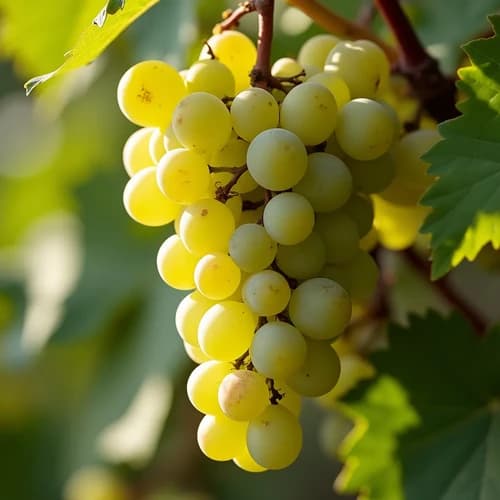





Introduction
Malvasia is not a single grape variety but an entire family – one of the oldest and most far-flung in the wine world. For centuries, traders shipped vines and wines across the Mediterranean, and today Malvasia varieties can be found in Italy, Portugal (including Madeira), Spain, Greece, the Canaries and Croatia. The name is historically linked to Monemvasia in Greece, once an important port for the wine trade. What unites the family is an unmistakably aromatic, full-flavoured character: ripe orchard fruit, honey, nuts and a delicate, faintly musky scent. From bone-dry everyday whites to rich, sweet Madeira, Malvasia displays a versatility that few other grapes can match.
Flavour Profile & Characteristics
Malvasia is among the most aromatic of all white grape families. In the glass, juicy stone-fruit aromas of apricot and peach dominate, joined by ripe orchard fruit such as pear and apple. Over these settles a honeyed note, often accompanied by dried fruit, a hint of almonds and the scent of white flowers. Characteristic, too, is a subtly waxy, musky impression that gives the family its unmistakable signature.
Unlike many fresh, acid-driven whites, Malvasia usually shows low to moderate acidity. This makes the wines soft, round and approachable, but it demands care from the winemaker to preserve freshness and drinkability. The body is medium to full, and in the dry styles the alcohol content frequently sits between 12 and 13.5% by volume.
Depending on the variety and origin, the profile varies considerably: some Malvasia types come across as delicate and floral, others powerful and opulent. This range is no accident but an expression of the genetic diversity within the family – each region and each variety brings out its own facet.
Origin & History
The story of Malvasia reaches far back into antiquity. Its name is usually derived from Monemvasia, a fortified port in southern Greece that was famous in the Middle Ages as a hub for sweet, powerful wines. From there, vines and wines spread throughout the Mediterranean along Venetian and other trade routes.
Over the centuries, Malvasia travelled from island to island and from coast to coast. In Italy numerous strains took root; in Portugal it found its way onto the mainland and to Madeira; in Spain and the Canaries distinct varieties emerged; and it also became established in Croatia. This wide dispersal explains why there is no single "Malvasia" today, but rather a whole family of closely and distantly related vines.
This diversity is at once a strength and a challenge: it makes Malvasia one of the most exciting grape groups, while complicating any blanket description. To understand Malvasia, one must grasp it as an umbrella term behind which dozens of distinct wine types are concealed.
Viticulture & Terroir
As a Mediterranean family, Malvasia favours warm, sunny climates in which the grapes can fully develop their aromatic ripeness. Warmth encourages the generous fruit and high aromatic content but can further lower the already-moderate acidity – which is why cooler sites, altitude or maritime influences are often welcome to retain freshness.
The family is grown on very different soils, from volcanic ground on the Mediterranean islands to the limestone and sandy soils of the mainland. On Madeira, the subtropical, humid, terraced terroir shapes the character of the vines, while on Sicily and Sardinia the sun and proximity to the sea leave their mark.
Important varieties within the family include Malvasia di Candia, Malvasia Istriana, the Portuguese Malvasia Fina, the Malvasia delle Lipari used for sweet island wines, and the Spanish Malvasía cultivated for instance in Rioja. Each of these vines has its own demands on site and climate – further evidence of the remarkable breadth of the group.
Wine Styles & Variants
Few grape families cover as broad a stylistic spectrum as Malvasia. Most widespread are dry white wines that put the variety's aromatic fruit and floral spice in the foreground. Alongside these are off-dry and emphatically aromatic versions that highlight the natural sweetness and honeyed note of the family.
In Tuscany, Malvasia is a traditional partner in Vin Santo, the sweet straw wine for which the grapes are dried after harvest before maturing over a long period in small barrels. It is often combined here with Trebbiano – a classic duo that marries aromatics and structure. Anyone wishing to learn more about this drying technique will find a closer explanation in the glossary entry on appassimento.
Most famous of all, however, is Malvasia as the basis of Malmsey, the richest and sweetest classic style of Madeira. This fortified wine unites intense sweetness with vibrant acidity and can age for decades, developing aromas of caramel, dried fruit and nuts. For more on the growing region, see the profile of the island of Madeira.
Increasingly, Malvasia is also used for orange wines, in which the must ferments on the skins for an extended time. This skin contact gives the wines structure, texture and additional aromatic depth – a modern expression of an ancient grape family.
Typical Aromas
Primary Aromas (from the grape)
Apricot & peach: The aromatic heart of Malvasia. Juicy stone-fruit aromas characterise most wines and give them their inviting, fruit-forward quality.
Ripe orchard fruit: Pear and ripe apple complement the stone fruit, lending the wines fullness and a gentle sweetness on the palate.
Honey & white flowers: A honeyed note and the scent of white flowers are among the most characteristic traits of the family and underline its aromatic richness.
Almond & musky spice: A fine almond tone and a subtle, faintly waxy, musky impression give Malvasia its unmistakable signature.
Secondary Aromas (from winemaking)
Lees & brioche: With ageing on the fine lees, creamy, yeasty notes develop along with a hint of freshly baked pastry, lending the wines more texture.
Spice from skin contact: Orange wines made from Malvasia show additional spicy and slightly tannic nuances from the skin contact, which complement the fruit profile.
Tertiary Aromas (from ageing)
Caramel & dried fruit: Especially in fortified styles such as Malmsey, the aromas mature into caramel, raisins, figs and dried fruit – a hallmark of long barrel ageing.
Nuts & toffee: With increasing age, nutty tones of walnut and almond emerge along with hints of toffee, lending the sweetness depth and complexity.
Candied peel: Mature dry Malvasia can develop aromas of candied citrus and orange peel without losing its fruit.
Ageing potential depends greatly on style: fresh, dry Malvasia is made for early enjoyment, while fortified sweet wines such as Malmsey rank among the longest-lived wines in the world and can mature over many decades.
Food Pairing
Perfect Combinations
Seafood & fish (dry Malvasia): Dry, aromatic Malvasia wines are ideal companions for prawns, mussels, pan-fried fish and light seafood pasta dishes. The low acidity and floral fruit caress the delicate flavour of the food without overwhelming it.
Light poultry & Mediterranean vegetables: With chicken, turkey or grilled vegetables with olive oil and herbs, the rounded fullness of dry Malvasia works beautifully. It also unfolds its charm with creamy risottos or antipasti.
Blue cheese & nuts (sweet Malmsey): The rich, sweet Malmsey style is the classic partner for robust blue cheese. The contrast of saltiness and sweetness creates a striking harmony, rounded out further by roasted nuts.
Dried fruit & chocolate desserts (sweet Malmsey): With dried fruit, figs, dates and dark-chocolate desserts, sweet Malmsey is an incomparable companion. Its aromas of caramel and dried fruit mirror the dessert, while the acidity balances the sweetness.
Malvasia is less a grape variety than a universe: an ancient Mediterranean family that stretches from bone-dry whites to legendary sweet Madeira. Those who embrace its diversity discover one of the most fascinating and history-laden groups in the wine world.