


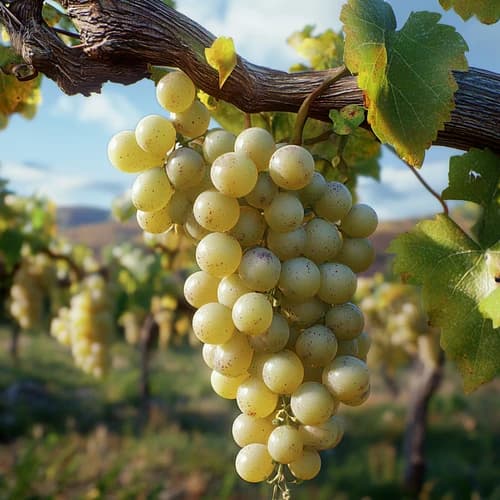


Chenin Blanc: The Chameleon of White Wines
Chenin Blanc is a white grape variety from France's Loire Valley – and arguably the most versatile white wine grape of all. It can do everything: from crisp, dry everyday wines through opulent barrique-aged expressions to legendary nobly sweet rarities capable of ageing for decades. While it produces some of France's noblest white wines in its homeland, it has found a second home in South Africa – today there are more Chenin Blanc vines planted there than anywhere else in the world.
Flavour Profile & Characteristics
Describing Chenin Blanc is a challenge, for this variety shows more faces than any other white grape. Its hallmark is a vibrant, sometimes almost electrifying acidity that lends freshness and tension even to fully ripe grapes.
In its simplest form, Chenin Blanc presents itself as an uncomplicated, fruit-forward white wine with aromas of green apple and pear, threaded through with a refreshing citrus note. These wines are perfect for everyday drinking – light, accessible and juicy.
Yet its true potential emerges at higher quality levels: here Chenin Blanc develops a fascinating complexity with notes of quince, ripe apple and honey, underpinned by a characteristic minerality reminiscent of wet slate. The wines gain in body and texture without losing their defining acidity – a combination that very few varieties master so perfectly.
The profile varies considerably depending on climate and ageing: in cooler regions like the Loire, citrus fruits, green apple and a cool minerality dominate. In warmer areas such as South Africa, riper fruit aromas, tropical notes and a fuller texture emerge. Barrique ageing adds creaminess and notes of brioche, butter and roasted nuts.
With age, Chenin Blanc undergoes a fascinating transformation: the primary fruit gives way to complex honey and beeswax notes, roasted nuts, dried fruits and a characteristic petrol note. The acidity feels integrated, the texture becomes silkier, and a depth emerges that can rival great Burgundies.
Origin & History
Chenin Blanc comes from the Loire Valley in France, where the variety was documented as early as the 9th century at the monastery of Glanfeuil near Angers. In the 15th century, Thomas Bohier, owner of Château de Chenonceau, had the variety planted on a large scale – which may also be the origin of the name "Chenin."
The Loire, especially the regions of Anjou, Saumur and Touraine, became home to some of the world's most legendary Chenin Blanc wines. Appellations such as Vouvray, Savennières, Quarts de Chaume and Bonnezeaux have been producing world-class wines for centuries.
In the 17th century, Dutch settlers brought the variety to South Africa, where it was long known as "Steen." There Chenin Blanc found ideal conditions and developed into the country's most important white wine – today there are more Chenin Blanc vines planted there than anywhere else in the world.
Chenin Blanc is now also grown in California, Argentina, Australia and New Zealand, but remains most significant in France and South Africa.
Viticulture & Terroir
Chenin Blanc is an adaptable but demanding variety. It prefers temperate to warm climates with cool nights that preserve its characteristic acidity. The grape ripens relatively late, which in cooler regions leads to an extended growing season and allows complex aromatic compounds to develop.
The variety is susceptible to Botrytis cinerea (noble rot), which in some regions poses a risk but in others is deliberately harnessed for the production of nobly sweet wines. Chenin Blanc can thrive on various soils but shows particular distinction on limestone, slate and tuffeau.
- Loire Valley (France): The classic home. Cool continental climate, soils of slate, tuffeau and chalk. Wines of impressive minerality and elegance are produced here.
- Western Cape (South Africa): Warmer climate with maritime influences, diverse soils from granite to slate. South African Chenin Blanc tends to be fruitier and fuller than its French counterpart.
- California: Mainly in Central Coast and Clarksburg. A warmer climate leads to ripe, opulent wines with tropical notes.
Wine Styles & Variants
The stylistic diversity of Chenin Blanc is unparalleled:
Dry and light: Simple, fruity wines for everyday enjoyment. Usually drunk young, with clear fruit aromas and refreshing acidity. Particularly common in South Africa.
Dry and complex: Age-worthy wines with barrique ageing, often with lees contact. These wines show depth, creaminess and can age for decades. Typical of top Loire appellations such as Savennières.
Off-dry (Demi-Sec): With a touch of residual sweetness, perfectly balanced by the high acidity. Ideal with Asian cuisine and spiced dishes.
Sweet to nobly sweet: From lightly sweet Moelleux wines to legendary botrytis expressions such as Quarts de Chaume or Bonnezeaux. These wines are among the longest-lived in the world and can age 50–100 years.
Sparkling wine: In the Loire, Chenin Blanc is an important component of Crémant de Loire and the famous Saumur Mousseux. The high acidity makes the variety ideal for sparkling wines.
Chenin Blanc is rarely used in blends since the variety is so versatile on its own. In South Africa, occasional blends with Viognier or Grenache Blanc are found, bringing additional aromatic complexity.
Typical Aromas
Primary Aromas (from the grape)
Green apple: The centrepiece of Chenin Blanc. Particularly pronounced in cooler climates, it gives the wine freshness and crispness.
Quince: A characteristic aroma that distinguishes Chenin Blanc from other white wines. Dominant particularly at intermediate ripeness, it brings a slightly tart, aromatic note.
Honey: Even in dry wines a subtle honey note often appears, which becomes more intense with greater grape ripeness.
Acacia: Delicate, floral notes that appear primarily in Loire wines. Lends elegance and fragrance.
Wet slate: The characteristic minerality, particularly pronounced on slate soils. Gives the wine tension and depth.
In warmer climates, additional aromas such as ripe pear, pineapple and mango appear, while cool regions emphasise citrus fruits and gooseberry.
Secondary Aromas (from winemaking)
Brioche and butter: With barrique ageing and lees contact, creamy, yeasty notes develop that evoke fresh pastry.
Roasted almonds: Through oak ageing and oxidative maturation, nutty notes arise that give the wine structure and complexity.
Vanilla and toast: With moderate oak cask ageing, classic wood notes appear that complement the fruit without dominating it.
Tertiary Aromas (from ageing)
Beeswax: A classic ageing aroma of great Chenin Blancs. Develops after 5–10 years of bottle age.
Lanolin and petrol: With long cellaring (15+ years), these characteristic, slightly oily notes emerge that make the wine unmistakable.
Dried fruits: Prunes, dried apricots and candied fruits appear in aged sweet Chenin Blancs.
Chenin Blanc is among the most age-worthy white wines in the world. While simple wines should be drunk young, high-quality dry Chenin Blancs can age 10–30 years. Nobly sweet botrytis wines from top vintages are practically immortal and develop over 50–100 years.
Food Pairing
Perfect Combinations
Fresh goat's cheese and salad (with dry Loire Chenin): The classic pairing. The wine's high acidity cuts through the creaminess of the cheese while the mineral notes underline the freshness of the salad. Crottin de Chavignol or young Selles-sur-Cher in particular harmonise perfectly.
Pork with apple and cider sauce (with South African Chenin): The fruitiness and body of South African Chenin Blanc complement the light sweetness of the sauce, while the acidity balances the richer meat. Also excellent with veal escalope in cream sauce.
Thai curry with coconut milk (with off-dry wines): The residual sweetness tempers the heat of the curry, the acidity refreshes, and the fruity aromas harmonise with the spices. A match that shows just how versatile Chenin Blanc is.
Foie gras or blue cheese (with nobly sweet Chenin): Sweet Chenin Blancs from Vouvray or Quarts de Chaume rank among the finest companions for foie gras or a powerful Roquefort. The acidity perfectly balances the fat and sweetness, while the honey notes of the wine blend with the complex flavours of the food.
Chenin Blanc is a true all-rounder at the table – from light starters through Asian dishes to demanding main courses and even desserts, there is almost nothing this variety cannot accompany.