




Introduction
Assyrtiko is the shining star on the Greek white wine horizon -- a grape that ripens to incomparable greatness on the volcanic soils of Santorini. With its razor-sharp acidity, salty minerality and ability to preserve freshness even in Mediterranean heat, Assyrtiko shows what white wine can be when tradition meets terroir. This ancient Cycladic grape is Greece's answer to Chablis and Riesling -- and stands equal to them in every way.
Flavor Profile & Characteristics
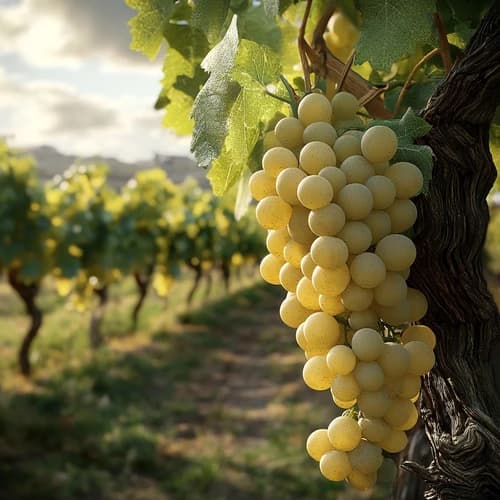
Assyrtiko is a grape of contrasts and extremes. In the glass, the wine presents itself in brilliant pale yellow to luminous gold, often with greenish reflections in its youth.
What makes Assyrtiko so extraordinary is the combination of razor-sharp acidity and full, almost oily body -- a quality rarely found in this form. The acidity is electric and vibrant, reminiscent of the finest Rieslings or Chablis, yet unlike these lighter-footed wines, Assyrtiko brings a powerful structure and fullness that gives it weight and presence.
The flavor profile is dominated by intense citrus aromas -- lemon, lime and grapefruit -- that never seem sweet but always precise and almost austere. Added to this is a pronounced minerality that shows different facets depending on origin: on Santorini, these are smoky, volcanic notes of wet flint and sea salt; on the mainland, more chalky, stony nuances.
Particularly fascinating is the salty, almost iodine-like component that distinguishes Assyrtiko from Santorini. This salinity comes from the strong winds that drive salty sea spray across the vineyards, giving the grapes their unmistakable terroir profile. On the palate, the wine feels juicy and concentrated, with a long, mineral finish that lingers for minutes after the sip.
With age, Assyrtiko develops additional complexity: honey notes, beeswax and roasted almonds emerge, while the acidity softens somewhat but never loses its freshness. High-quality Assyrtiko wines from Santorini can easily age 10-20 years, gaining depth and elegance along the way.
Origin & History
The history of Assyrtiko stretches back to antiquity. Viticulture has been practiced on Santorini for over 3,000 years -- the grape could be among the oldest still-cultivated varieties in the world. The Minoan civilization was already growing wine here, long before the Phoenicians spread viticulture across the Mediterranean.
The name "Assyrtiko" is connected by some researchers to Assyrian trade, while others see its origin in the Greek word "asyrítos," meaning "unmixed" -- a reference to the grape traditionally being produced as a varietal wine.
Santorini's unique history has shaped Assyrtiko: the devastating volcanic eruption in the 16th century BC, which wiped out the Minoan civilization, left behind the bizarre volcanic soils on which Assyrtiko thrives today. The island's isolation and extreme conditions led the grape to adapt perfectly to drought, strong winds and intense sun exposure.
A special gift of this isolation: phylloxera, which destroyed almost all European vineyards in the late 19th century, never reached Santorini. That is why ungrafted vines still stand here today -- some over 100 years old -- planted directly into the volcanic sand without rootstock. A living viticultural museum.
Today, approximately 1,200 hectares of Assyrtiko are cultivated in Greece, the majority on Santorini. But on the mainland as well -- in Chalkidiki, Macedonia and Drama -- the grape increasingly shows its potential, albeit with a different character.
Cultivation & Terroir
Assyrtiko is a robust grape, adapted to extreme conditions, that develops its greatest quality precisely in inhospitable sites.
Climate conditions: The grape loves heat and drought. On Santorini, there is barely any rain (only 400mm per year), but strong northerly winds (Meltemi) and intense sun exposure. The vines survive thanks to nighttime dew and moisture from sea breezes. These extreme conditions lead to concentrated grapes with high sugar content and simultaneously high acidity -- a rare combination.
Soil requirements: On Santorini, the vines grow in pure volcanic sand, pumice and volcanic ash -- practically without humus. These extremely nutrient-poor, permeable soils force the vines to root deeply and yield little. The result: highly concentrated grapes with intense minerality. On the mainland, Assyrtiko also thrives on limestone and clay, producing somewhat more approachable wines.
"Kouloura" training system: On Santorini, the vines are trained in unique, basket-shaped nests close to the ground. The shoots are woven spirally and form a protected basket in which the grapes ripen inside, sheltered from wind and sun. This ancient system is an ingenious adaptation to the island's extreme wind conditions.
Important wine regions:
- Santorini PDO: The epicenter and soul of Assyrtiko. Wines from here are unmistakably mineral, salty and complex. The best sites are at higher elevations around Pyrgos and Megalochori.
- Chalkidiki: On the mainland, especially around the Sithonia peninsula, more approachable, fruitier Assyrtikos with somewhat less minerality are produced.
- Drama & Macedonia: Cooler regions of northern Greece, where Assyrtiko produces elegant, acid-driven wines.
- Paros: Another Cycladic island with growing Assyrtiko cultivation.
Wine Styles & Variants
Assyrtiko shows itself in various guises, from bone-dry to opulently sweet:
Classic dry Assyrtiko (stainless steel): The purist variant shows the grape in its purest form. Aged in stainless steel tanks, the wine preserves maximum freshness, crisp acidity and clear fruit. Citrus aromas, minerality and salinity take center stage. Perfect as an aperitif or with seafood (13-14.5% alcohol).
Barrique-aged Assyrtiko: More and more winemakers are experimenting with oak barrel aging. The result is powerful, complex wines with creamy texture, vanilla notes and roasted almonds. The acidity and minerality are preserved but gain more depth and structure. These wines can age well for 10-15 years (14-15% alcohol).
Vinsanto: Santorini's sweet answer to Port or Sauternes. From sun-dried Assyrtiko grapes (often blended with Aidani and Athiri), an oxidative sweet wine with aromas of dried figs, caramel, coffee and nuts is produced. Aged at least 3 years in barrel, great Vinsantos can last for decades.
Wild Ferment & Natural Wines: Modern winemakers increasingly produce spontaneously fermented Assyrtikos with longer skin contact or aging in amphorae. These wines are textured, complex and show an additional dimension.
Regional differences: Santorini Assyrtiko is the benchmark -- intense, mineral, salty, with impressive aging ability. Mainland Assyrtiko is more approachable, fruitier and less salty, but often with lovely citrus freshness and floral notes.
Blending partners: While Assyrtiko often shines as a varietal, it is traditionally blended on Santorini with Aidani (adding florality and elegance) and Athiri (adding fruit and roundness). Modern blends with Sauvignon Blanc or Malagousia on the mainland are also interesting.
Typical Aromas
Primary Aromas (from the grape)
Lemon & lime: The backbone of the Assyrtiko profile. Intense, almost concentrated citrus aromas dominate, never sweet but always fresh and precise. On Santorini, with an almost austere, lemon-peel note.
Green apple: Especially in cooler years or younger wines, crisp notes of green apple and pear appear, bringing additional freshness.
Minerality & flint: The signature of Santorini Assyrtiko. Wet stones, smoky flint, wet slate -- these mineral notes are so pronounced that you can practically taste the volcano.
Salinity & iodine notes: The famous salty component comes from the sea spray that blows across the vineyards. A subtle but characteristic note reminiscent of oyster shells or sea breeze.
White flowers & herbs: Delicate notes of linden blossom, chamomile and Mediterranean herbs (oregano, thyme) add complexity and underscore the Mediterranean origin.
Secondary Aromas (from winemaking)
Yeast notes & brioche: With longer lees aging (sur lie), creamy, brioche-like notes develop that give the wine more texture and fullness -- especially in high-quality Santorini wines.
Vanilla & roasted almonds: With barrique aging, these aromas are added without masking the characteristic minerality. Oak use should be subtle to avoid dominating the grape.
Butter & cream: With malolactic fermentation (rare, but sometimes in barrique-aged wines), creamy, buttery notes develop.
Tertiary Aromas (from aging)
Honey & beeswax: With 5-10 years of aging, high-quality Assyrtikos develop these noble, waxy notes that signal depth and complexity.
Dried fruits & nuts: Aged wines show aromas of dried apricots, candied lemons and roasted hazelnuts -- signs of noble age.
Petrol & kerosene: Similar to Riesling, very old Assyrtikos (15+ years) can develop fine petrol aromas that are prized by connoisseurs.
Aging potential: Assyrtiko belongs among the longest-lived white wines in the world. Simple mainland wines should be drunk young (2-4 years). High-quality Santorini Assyrtikos from stainless steel develop over 8-12 years, while barrique-aged top wines can easily age 15-20 years. Vinsanto can even have 30-50 years and more on its back.
Food Pairing
Perfect Combinations
Seafood & fish (raw, grilled or fried): Here Assyrtiko plays its greatest strength. The salty minerality harmonizes perfectly with raw oysters, sea urchin or sashimi. With grilled octopus, pan-seared sea bass or shrimp with lemon, a classic Santorini Assyrtiko is a revelation. The acidity cuts through the oil, the salinity complements the sea.
Greek mezze & appetizers: Tzatziki, taramosalata, grilled feta, dolmades, fried calamari -- Assyrtiko is the perfect companion for Greek appetizer culture. The acidity balances creamy dips, the minerality complements salty components, and the wine's fullness stands up to savory flavors.
Goat cheese & fresh cheeses: A barrique-aged Assyrtiko is spectacular with creamy goat cheese, feta or young Pecorino. The acidity cuts through the creaminess, the minerality harmonizes with the salty note of the cheese.
Poultry & pork (Mediterranean-style): Lemon chicken, herb-roasted pork or stuffed calamari with rice find a powerful partner in the full-bodied Assyrtiko. The wine's citrus aromas mirror the preparation, the acidity brings freshness.
Pro tip: Vinsanto is an absolute insider tip with blue cheese (Roquefort, Gorgonzola), dried figs or nut cake. The oxidative notes and concentrated sweetness harmonize perfectly with intense flavors. An aged, barrique-aged Assyrtiko can even be served with lighter meat dishes such as veal cutlet or chicken in cream sauce -- its fullness carries the richer textures.
Assyrtiko is Greece's proudest white wine grape -- proof that extreme terroir produces extraordinary wines. From the wind-swept volcanic soils of Santorini to your wine glass: discover the electrifying power of this ancient Mediterranean variety.